AI Appraisal Estimate

AI-generated estimates · not official valuations

From the user

What was submitted

Photo and notes provided by the user — not generated by AI

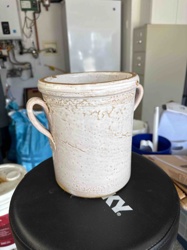
Submitted item photo
Submitted photo · June 19, 2026

User's notes

No additional notes provided.

AI analysis below

AI appraisal

AI analysis & estimate

AI-Generated · Verify before acting

Everything below is generated by AI for informational purposes only. AI can make mistakes — the AI may misidentify items or misattribute them (artist, maker, brand, designer, origin, era). This is not an official valuation and should not be used for insurance, sale, tax, estate, legal, or lending purposes — or any decision requiring a certified appraisal. It is not an authoritative claim about any person, brand, or rights holder — do not share or rely on it as a factual statement about a third party. Always consult qualified professionals before making financial decisions.

Read the full disclaimer

AI Identification

·Not independently authenticated·Verify before acting

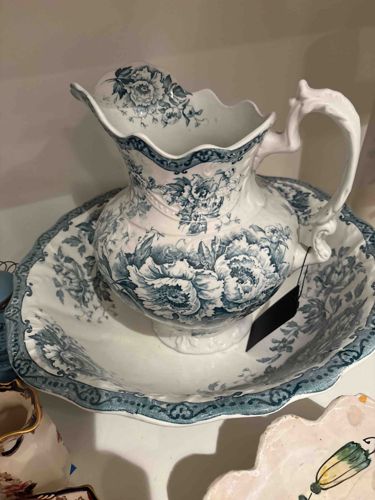
Victorian Style Blue and White Flow Blue Wash Basin and Pitcher Set

Antique Ceramics and Pottery

AI Estimated Value

·Not an official valuation·Verify before acting

$150 - $250

As of June 19, 2026

AI Item Analysis

·AI can make mistakes·Verify before acting
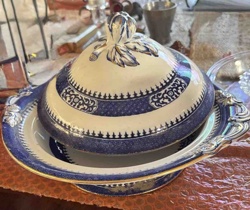
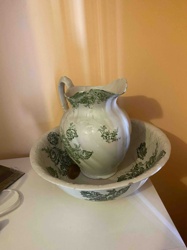
This is a two-piece ceramic wash set consisting of a large pitcher and a deep matching basin, rendered in a classic blue and white transferware style frequently referred to as 'Flow Blue.' The set features a crisp white glaze base decorated with intricate teal-blue floral motifs, specifically large peonies and foliage, which are representative of late 19th-century Victorian design. The pitcher is characterized by a bulbous midsection, a flared scalloped rim, and an ornate, scrolled rococo-style handle with molded textural details. The basin plate mirrors the floral pattern along its wide, scalloped rim and interior. Both pieces exhibit a slightly blurred or 'flowing' quality to the blue pigment, indicative of the chemical reaction during firing that makes Flow Blue highly decorative. The construction appears to be high-fired earthenware or ironstone, designed for durability as well as aesthetic appeal. Regarding condition, the set appears well-preserved with no major visible cracks, though fine overall crazing in the glaze is expected for ceramics of this age. There are no immediate signs of repairs or heavy staining. This set likely dates to the late 19th or early 20th century (1880-1910) and represents high-quality household craftsmanship used for daily hygiene prior to indoor plumbing. Maker's marks are not visible in the photo but would likely be stamped on the underside of the base.
AI Appraisal Report

·AI can make mistakes·Verify before acting
Based on my visual examination of the images provided, this two-piece wash set appears to be a lovely example of late Victorian or Edwardian-era transferware, executed in the style commonly known as 'Flow Blue.' The condition appears quite good; the structural integrity seems intact with no obvious chips or hairline cracks visible on the rim or handle—areas notoriously prone to damage. I note the characteristic blurring of the cobalt transfer, which suggests standard manufacturing techniques of the 1890-1910 period, likely on an ironstone body. The rococo-style molded handle and scalloped rims add desirable decorative appeal. The current market for large-scale utilitarian ceramics like wash sets has softened significantly compared to peak antique market trends. While Flow Blue remains collectible, functional pieces like these are now primarily valued for interior decoration rather than strict investment. Comparable non-branded or lesser-known maker sets in this condition generally hammer at auction between $100 and $200, with retail prices slightly higher in antique malls. It is critical to note that without handling the item, I cannot inspect the underside for maker's marks (e.g., Staffordshire potters like Johnson Bros or Ridgways), which could double the value if a prestigious name is present. Furthermore, photographs cannot reveal professional restoration, which can be detected only via UV light or tactile inspection. I have assumed the 'crazing' mentioned is consistent with age and not indicative of a compromised glaze structure. For a definitive valuation, I would need to see the maker's mark and sound the pottery for hidden cracks.

Get your items appraised

Instant estimates of your treasures with AI-powered appraisals

Browse More Appraisals