AI estimate as of November 9, 2025 · verify with a professional before acting
AI-Generated · Verify before acting
Everything on this page is generated by AI for informational purposes only. AI can make mistakes — the AI may misidentify items or misattribute them (artist, maker, brand, designer, origin, era). This is not an official valuation and should not be used for insurance, sale, tax, estate, legal, or lending purposes — or any decision requiring a certified appraisal. It is not an authoritative claim about any person, brand, or rights holder — do not share or rely on it as a factual statement about a third party. Always consult qualified professionals before making financial decisions.
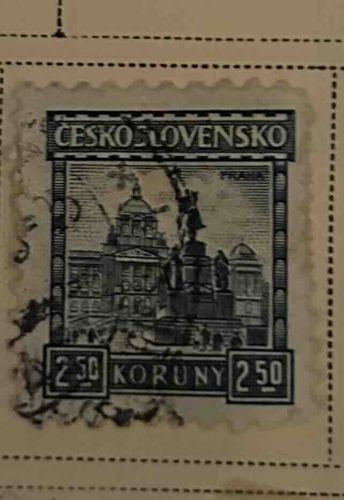
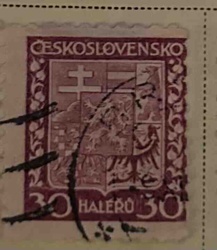
This is a rectangular postage stamp from Czechoslovakia, featuring a monochromatic depiction of a significant architectural and sculptural landmark. The stamp's primary color appears to be a dark blue or black print on a light, possibly off-white or yellowish, paper base. The design is framed by a thin black border, and the words 'CESKOSLOVENSKO' are prominently displayed at the top within a rectangular panel, indicating its country of origin. Below this, in a smaller font, the word 'PRAHA' is visible, suggesting the city depicted is Prague. The central image shows a large, classical-style building with a domed roof and columns, likely a significant public edifice. In front of this building stands a prominent equestrian statue on a pedestal, flanked by other smaller sculptural figures, typical of a historical square or monument. The denomination '2 50 KORUNY 2 50' is clearly visible at the bottom of the stamp, with 'KORUNY' (Koruna, the currency) centrally placed between two '2 50' numerals, each enclosed in a box. The stamp exhibits classic perforation around its edges, indicating it was part of a sheet and intended for postage. The visible condition includes some smudging or cancellation marks in the bottom left corner, suggesting it might be used. The color density and fine lines indicate a high-quality printing process, likely intaglio or lithography, common for postage stamps of the early to mid-20th century. The slightly yellowed paper hints at age, placing its estimated age sometime between the 1920s and 1950s, a period when Czechoslovakia existed as an independent nation. The craftsmanship appears to be of good quality, with clear details in the architectural and sculptural elements despite the small scale.
AI Appraisal Report
I have carefully examined the provided image of the Czechoslovakian 2.50 Koruny stamp featuring Praška. The stamp appears to be a genuine issue from Czechoslovakia, likely from the interwar period (1920s-1930s) based on the currency and style. The visual details, including the 'CESKOSLOVENSKO' inscription, 'PRAHA,' and the architectural depiction, align with known issues of this era. The color density and fine lines suggest a quality printing process typical for postage stamps.
Regarding condition, the stamp shows evidence of a cancellation mark in the bottom left, indicating it is a used copy. The slight yellowing of the paper is consistent with age. Perforation appears intact but I cannot assess its full integrity from the image alone. Without a physical inspection, I cannot definitively comment on the gum status, paper flaws, thinning, or hidden creases, which are all critical factors for stamp valuation.
The market for common used Czechoslovakian stamps from this period is generally modest. While historically significant, these stamps were produced in large quantities. Demand is steady among thematic collectors (e.g., architecture, statuary) and general Czechoslovakian philatelists, but it is not exceptionally high for average used examples. Rarity is not a significant factor for this particular denomination in used condition.
Based on my visual assessment, the estimated value for this stamp in its apparent used condition, assuming no major hidden flaws, would be in the range of $5 to $15. This reflects its authenticity as a genuine stamp and its collectibility. To provide a more precise valuation and authenticate fully, a physical examination would be necessary to check for watermarks, paper varieties, precise perforation measurements, gum condition, and potential repairs or alterations that are not visible in the image.