AI estimate as of November 8, 2025 · verify with a professional before acting
AI-Generated · Verify before acting
Everything on this page is generated by AI for informational purposes only. AI can make mistakes — the AI may misidentify items or misattribute them (artist, maker, brand, designer, origin, era). This is not an official valuation and should not be used for insurance, sale, tax, estate, legal, or lending purposes — or any decision requiring a certified appraisal. It is not an authoritative claim about any person, brand, or rights holder — do not share or rely on it as a factual statement about a third party. Always consult qualified professionals before making financial decisions.
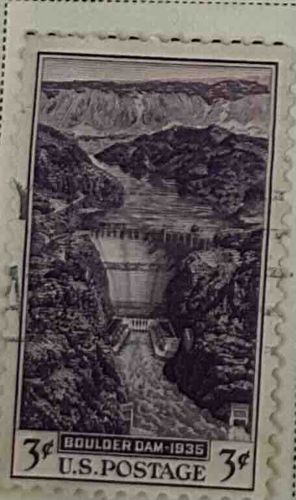
This item is a single, rectangular United States postage stamp, bearing the denomination of '3¢'. The stamp is printed in a monochromatic purple or deep indigo ink on what appears to be off-white or cream-colored paper. Its edges exhibit distinct, uncolored perforations, indicating it was separated from a sheet of stamps. The central image depicts a detailed engraving of Boulder Dam (later renamed Hoover Dam) nestled within a mountainous gorge, with a river flowing from it. The dam itself is prominently featured, showcasing its massive concrete structure and the water cascading from its upper sections. The surrounding landscape illustrates rough, rocky terrain and distant plateaus under a textured sky, rendered with fine lines characteristic of intaglio printing. Below the main image, within a rectangular border, are the inscriptions: 'BOULDER DAM - 1935' above 'U.S. POSTAGE'. The '3¢' denomination is repeated in both lower corners, flanking the text box. The stamp shows signs of some wear, with minor discoloration or possible staining visible on the top left edge of the white border, and slight creasing or age-related imperfections may be present although not overtly clear. The perforations appear largely intact, though some might be less crisp than others. The overall condition suggests it is a used or unmounted mint stamp, with an estimated age aligning with its '1935' inscription, typical of mid-20th century philatelic items. The quality of the engraving is fine, offering good detail in the architectural and natural elements of the scene, reflecting standard U.S. postal stationery craftsmanship of the era.
AI Appraisal Report
I have carefully examined the provided image of the Boulder Dam - 1935 U.S. Postage Stamp. This 3-cent stamp, featuring the Boulder Dam (Hoover Dam) in a monochromatic purple/indigo, appears to be an authentic example of a U.S. postage stamp from that era. The design, denomination placement, and 'U.S. POSTAGE' inscription are consistent with known specimens of the Scott #771 issue.
From the image, the stamp's condition appears to be 'Fine' to 'Very Fine'. I note some minor discoloration or potential staining on the top left edge of the white border, and the perforations, while largely intact, may show some slight imperfections. This suggests it is either a used copy (though no cancellation is visible) or an unmounted mint stamp with some handling wear. The engraving quality is good, retaining fine detail.
This specific issue, Scott #771, was widely distributed. Market conditions show that even in pristine unmounted mint condition, its value is relatively modest. Used copies, particularly without a clear cancellation or significant aesthetic appeal from the cancellation, typically command lower prices. The discoloration I observe would slightly diminish its value compared to a flawless example.
Demand for this particular stamp is generally low to moderate among general collectors, as it is not a rare issue. Its value is primarily driven by its historical significance and aesthetic appeal, rather than scarcity. Factors significantly impacting value include the presence of original gum (if mint), absence of faults (thinning, tears, creases), and centered design.
It is crucial to note that my assessment of authenticity and condition is based solely on a visual examination of the image. For full authentication and a definitive condition assessment, an in-person examination would be required to verify the paper type, gum (if present), absence of hidden faults (e.g., repairs, reperforations), and actual color shade. Provenance documentation could also confirm its history, but is not typically available for such common issues. Without physical inspection, I cannot confirm the integrity of the gum or detect microscopic flaws.