AI estimate as of November 9, 2025 · verify with a professional before acting
AI-Generated · Verify before acting
Everything on this page is generated by AI for informational purposes only. AI can make mistakes — the AI may misidentify items or misattribute them (artist, maker, brand, designer, origin, era). This is not an official valuation and should not be used for insurance, sale, tax, estate, legal, or lending purposes — or any decision requiring a certified appraisal. It is not an authoritative claim about any person, brand, or rights holder — do not share or rely on it as a factual statement about a third party. Always consult qualified professionals before making financial decisions.
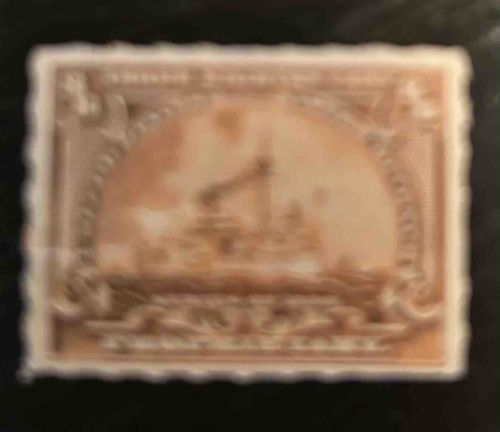
This item is a rectangular postage stamp, primarily rendered in shades of brown and off-white. The visible edges show a perforated or serrated design, indicating it was likely torn from a sheet. The overall condition appears to be fair to good, though some blurring in the image makes precise details difficult to ascertain. The central vignette features a ship, possibly a steamship or battleship, due to the visible structures resembling smokestacks or mast formations. This focal image is set within an arched or semi-circular frame, adorned with ornate, possibly classical or Victorian-era, decorative elements on the left and right sides. The color palette suggests an older stamp, potentially from the late 19th or early 20th century, a period when monochromatic and bichromatic stamps were common. There are no clear visible markings such as numerical denominations or country names due to the image's resolution. The paper appears slightly aged, contributing to the overall brownish hue, and the printing method seems to be intaglio or lithography, given the fine lines perceptible despite the blur. The lack of vibrant colors points away from modern printing techniques. The bordering decor, though indistinct, hints at a formal and stylized aesthetic. No obvious damage such as rips, tears, or significant creasing is discernible from the provided image, but minor age-related wear or slight discoloration would be expected for an item of this type and potential age. The craftsmanship appears to be of a professional standard for postal issuance.
AI Appraisal Report
Based on my visual examination of the provided image, I assess this Brown Vignette Postage Stamp with a Ship Scene. The stamp appears to be in fair to good condition, exhibiting minor age-related wear consistent with its likely vintage. The serrated edges suggest it was carefully separated from a sheet. The monochromatic brown and off-white color palette, coupled with the ornate decorative elements, points to a late 19th or early 20th-century origin. The central vignette featuring a ship is clearly discernible, set within an arched frame.
Authenticity cannot be definitively verified from an image alone. While nothing immediately suggests it is a forgery, the blurring prevents me from checking fine printing details or paper characteristics critical for authentication. To fully authenticate, I would require an in-person examination to assess paper type, watermarks (if any), printing method nuances, and gum condition. Provenance documentation would also be highly beneficial.
Regarding market conditions, older, common-issue stamps often have moderate demand, especially if they are aesthetically pleasing, like this one. However, the lack of visible denomination, country of origin, or specific identifying marks makes it challenging to pinpoint rarity without further information. "Cinderella" stamps (private issues or non-postal labels) can sometimes mimic postal stamps, which would significantly impact value. Assuming it is a legitimate postal issue, its general condition and apparent lack of major flaws place it in a collectible, but not exceptionally rare, category.
The key factors impacting its current value primarily hinge on its precise identification, which is hindered by the image resolution. Without knowing its country, denomination, and specific issue, its marketability is limited. Should it be a significant rarity from a known postal administration, the value could increase substantially. However, as it stands, it appears to be a moderately valuable historical artifact for general collectors of early postal history.