These notes were written by the person who submitted this item. Appraiser.AI has not verified them, and the AI's identification and estimate may rely on them.
AI Estimated Value
Not an official valuation
$0.50 - $2.00
AI estimate as of November 9, 2025 · verify with a professional before acting
AI-Generated · Verify before acting
Everything on this page is generated by AI for informational purposes only. AI can make mistakes — the AI may misidentify items or misattribute them (artist, maker, brand, designer, origin, era). This is not an official valuation and should not be used for insurance, sale, tax, estate, legal, or lending purposes — or any decision requiring a certified appraisal. It is not an authoritative claim about any person, brand, or rights holder — do not share or rely on it as a factual statement about a third party. Always consult qualified professionals before making financial decisions.
This analysis also relies on unverified notes provided by the user, which may be incomplete or inaccurate and could affect the result.
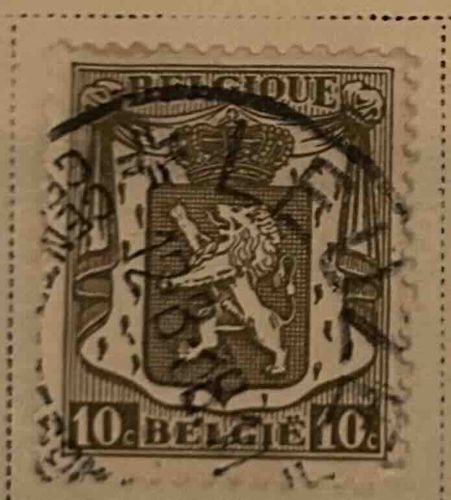
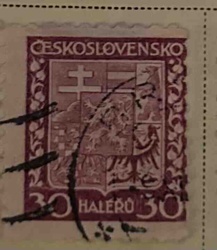
This item is a vintage Belgian postage stamp, featuring the national coat of arms. The stamp is rectangular in shape with perforated edges, typical of early to mid-20th-century philately. The central design showcases a crowned shield, within which a rampant lion is depicted, holding a sword and supported by a flowing drapery or ermine mantel, also surmounted by a crown. Above the central design, the word 'BELGIQUE' (French for Belgium) is visible across the top in an arch, and below the coat of arms, '10c BELGIE 10c' is printed, indicating a denomination of 10 centimes and the Dutch spelling for Belgium. The overall color scheme appears to be a monochromatic sepia or deep brown, giving it an aged aesthetic. The stamp exhibits visible signs of use, primarily a black circular postmark largely obscuring parts of the upper and central design, indicating it has been through the postal system. There are also smaller, less defined black marks on the lower left and right. The perforations appear intact, though some creasing or minor wear around the edges is possible given its age and use. The printing quality seems consistent with governmental philatelic production of its era, featuring fine lines in the heraldic design. The condition suggests it is a used, circulated stamp, likely from the late 19th to early 20th century, based on the design elements and currency denomination.
AI Appraisal Report
I have examined the image of the Belgium 10c Coat of Arms Postage Stamp. Based on a visual assessment, this stamp appears to be an authentic, used Belgian postage stamp from the late 19th to early 20th century, likely from the 'Lion Type' series. The design elements, including the crowned shield, rampant lion, and 'BELGIQUE' / 'BELGIE' inscriptions, are consistent with known issues from this period. The monochromatic sepia/deep brown color also aligns with typical printings.
The condition is typical for a used, circulated stamp of its age. The prominent circular postmark indicates postal use, but regrettably, it significantly obscures key design elements, which negatively impacts aesthetic appeal and therefore value. Other smaller black marks are also present. While the perforations appear largely intact, minor creasing or wear along the edges is expected and visible, consistent with practical use. No significant tears or major defects are immediately apparent, but without physical inspection, it is impossible to confirm the absence of thinning, creasing not visible in the image, or repairs.
Regarding market conditions, this specific type of Belgian stamp from the 'Lion Type' series is relatively common, especially in used condition. Comparables for similar used, postmarked examples generally range from minimal value to a few dollars, depending on the clarity of the postmark and overall preservation. The demand for common used stamps like this is moderate among general collectors, but rarely attracts high bids unless it possesses a rare postmark variation or exceptional centering. This particular example's heavy postmark reduces its desirability.
The primary factor impacting value here is the heavy postmark obscuring the central design, placing it firmly in the 'common used' category. Authenticity, based on the image, seems likely, but without in-person examination, I cannot definitively rule out sophisticated forgeries. A physical inspection would allow me to assess paper quality, watermarks (if any), gum condition (if unused), and microscopic print details. Provenance, such as purchase receipts or a collector's history, would also strengthen its authentication, but is not available here.