AI estimate as of July 10, 2025 · verify with a professional before acting
AI-Generated · Verify before acting
Everything on this page is generated by AI for informational purposes only. AI can make mistakes — the AI may misidentify items or misattribute them (artist, maker, brand, designer, origin, era). This is not an official valuation and should not be used for insurance, sale, tax, estate, legal, or lending purposes — or any decision requiring a certified appraisal. It is not an authoritative claim about any person, brand, or rights holder — do not share or rely on it as a factual statement about a third party. Always consult qualified professionals before making financial decisions.
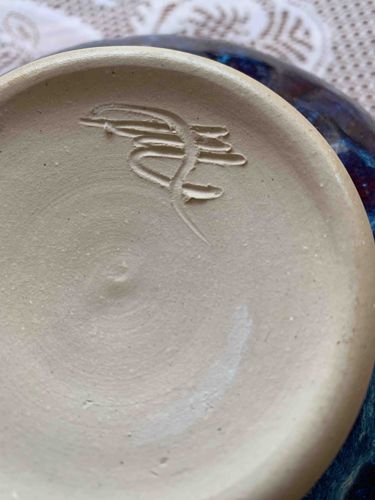
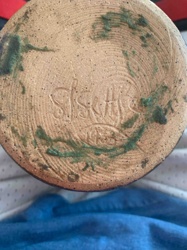
The item appears to be the base of a ceramic vessel, likely a bowl or vase, crafted from a light-colored, unglazed stoneware or pottery clay. The physical characteristics visible include a flat, circular base with a slightly raised foot-ring, typical of thrown pottery. The clay body itself is a light beige or off-white, exhibiting a matte, porous texture with minor rough spots and irregularities consistent with handmade craftsmanship. The most prominent feature is a deeply incised maker's mark or artist's signature, centrally located on the unglazed base. This mark consists of a stylized, abstract symbol that resembles a swirling or flowing character, possibly a monogram or an artistic rendering of a word, with clear, deliberate lines. The blue-purple, possibly reactive, glaze is visible along the rim of the foot-ring, suggesting the visible portion is indeed the underside of a glazed object. The glaze shows a mottled, variegated pattern with splashes of dark blue, lighter blue, and hints of purplish-red, indicating a unique firing process, possibly a high-fire or crystalline glaze. The condition appears good, with no visible chips, cracks, or significant wear on the unglazed base, aside from minor dust or surface residue. The quality indicators suggest a handmade, artisanal piece, with the distinct potter's mark confirming its origin from a specific artist or studio. The style period is difficult to ascertain precisely without more context, but the visible mark and glazing technique point towards contemporary studio pottery. The craftsmanship is evident in the precise execution of the foot-ring and the clear, intentional nature of the incised mark, showcasing the skill of the potter.
AI Appraisal Report
Upon examining the image of this Studio Pottery Bowl/Vase base, I assess its condition as good, with no visible damage on the unglazed portion. The authenticity, based solely on the visual evidence of the distinct maker's mark and consistent craftsmanship, appears high for an artisanal piece. However, without in-person examination, I cannot definitively confirm the clay body's texture, precise coloration, or absence of hairline cracks or repairs on other parts of the vessel. For full authentication, I would need to physically inspect the entire piece for structural integrity, examine the glaze quality in person, and review provenance documentation (e.g., artist's certificate, exhibition history). Scientific testing of the clay or glaze could offer further insights into its origin. Market conditions for contemporary studio pottery are generally strong, particularly for unique, artist-signed pieces. Comparables would include works by established contemporary ceramic artists utilizing similar high-fire or reactive glazes, which often command values in the mid-hundreds to low thousands. The demand for well-executed artistry with a unique aesthetic, like the striking blue-purple glaze partially visible, is healthy. The rarity is moderate; while artist-signed pieces are by nature unique, the broader category of studio pottery is sizable. The most significant factor impacting value is the identity and reputation of the artist associated with the incised mark. If this mark belongs to a well-known or collected potter, the value would significantly increase. Conversely, an unknown artist would place this piece closer to the lower end of the range. The clear, intentional nature of the mark strongly suggests an established practice. The overall craftsmanship observed on the base indicates a skilled hand.