These notes were written by the person who submitted this item. Appraiser.AI has not verified them, and the AI's identification and estimate may rely on them.
AI Estimated Value
Not an official valuation
$150-250
AI estimate as of September 6, 2025 · verify with a professional before acting
AI-Generated · Verify before acting
Everything on this page is generated by AI for informational purposes only. AI can make mistakes — the AI may misidentify items or misattribute them (artist, maker, brand, designer, origin, era). This is not an official valuation and should not be used for insurance, sale, tax, estate, legal, or lending purposes — or any decision requiring a certified appraisal. It is not an authoritative claim about any person, brand, or rights holder — do not share or rely on it as a factual statement about a third party. Always consult qualified professionals before making financial decisions.
This analysis also relies on unverified notes provided by the user, which may be incomplete or inaccurate and could affect the result.
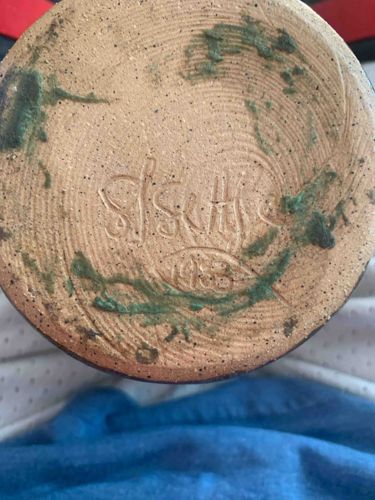
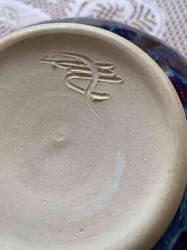
The item is a ceramic vase, as indicated by the context. The image provided focuses on the unglazed, natural stoneware base of the vase. The base is circular with visible concentric rings, typical of a piece thrown on a pottery wheel. The surface of the unglazed clay is a light, sandy brown or beige color with numerous small, dark speckles, indicative of grog or impurities in the clay body. There are distinct traces of green pigment or glaze splashes on the base, suggesting either an intentional decorative element or incidental drips during the glazing process of the upper portion of the vase. The most notable features are the incised markings. "S. GUTH" is clearly incised in a stylized script, likely the maker's signature. Below this, the numbers "1983" are also incised, indicating the year of manufacture. The incised details are clear and legible, demonstrating careful execution. The texture of the clay appears unrefined, giving it a rustic or earthy feel, consistent with studio pottery. There are no obvious signs of chips, cracks, or repairs visible in this specific view, suggesting a good overall condition for this part of the item. The green residue could be a result of the firing process or later use, such as staining from water or minerals if the vase contained liquid. The craftsmanship points to a handmade, artisan piece, with the uniqueness of its form and surface texture contributing to its character. The visible wheel marks suggest traditional pottery-making techniques.
AI Appraisal Report
Upon examining the provided image of the Studio Pottery Vase, focusing on its base, I note the clear incised signature 'S. GUTH' and the date '1983'. The concentric rings and unglazed stoneware suggest a piece thrown on a wheel, consistent with handmade studio pottery. The light sandy-brown clay with dark speckles indicates a natural, earthy material, enhanced by what appears to be incidental green pigment splashes, possibly from the glazing process of the upper portion. The condition of the base visible appears excellent; I observe no chips, cracks, or repairs, which bodes well for the overall integrity of the vase. The legibility of the incised marks confirms authenticity to a degree.
In terms of market conditions, studio pottery from established, though not necessarily internationally renowned, artists typically fetches modest prices unless there's significant auction history or a large collector base. The 1983 date places it within a period when studio pottery was gaining significant traction. Comparables for such pieces, absent full artist provenance, generally fall into the decorative arts category rather than fine art. Demand for such pieces is steady among collectors of artisanal ceramics or those seeking unique decorative objects. Rarity is difficult to assess without knowing the artist's output, but individual pieces like this are unique.
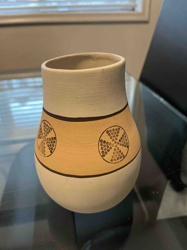
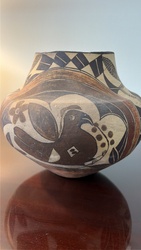
Factors impacting value include the artist's recognition, the overall aesthetic appeal of the entire vase (not just the base), and its condition. Without seeing the full vase, its form, glaze, and any other decorative elements, a precise valuation is challenging. My assessment is based solely on the part shown.
Limitations to authenticity verification from images alone are significant. While the incised signature and date are visible, I cannot definitively authenticate the artist or rule out later additions without an in-person examination to assess the tactile qualities, tool marks, and clay body in detail. Provenance documentation, such as purchase receipts or exhibition history, would be crucial for full authentication and could significantly impact value. Scientific testing of the clay body or glaze is typically not undertaken for pieces in this value range but could further confirm origin if necessary.