These notes were written by the person who submitted this item. Appraiser.AI has not verified them, and the AI's identification and estimate may rely on them.
AI Estimated Value
Not an official valuation
$150 - $300
AI estimate as of November 16, 2025 · verify with a professional before acting
AI-Generated · Verify before acting
Everything on this page is generated by AI for informational purposes only. AI can make mistakes — the AI may misidentify items or misattribute them (artist, maker, brand, designer, origin, era). This is not an official valuation and should not be used for insurance, sale, tax, estate, legal, or lending purposes — or any decision requiring a certified appraisal. It is not an authoritative claim about any person, brand, or rights holder — do not share or rely on it as a factual statement about a third party. Always consult qualified professionals before making financial decisions.
This analysis also relies on unverified notes provided by the user, which may be incomplete or inaccurate and could affect the result.
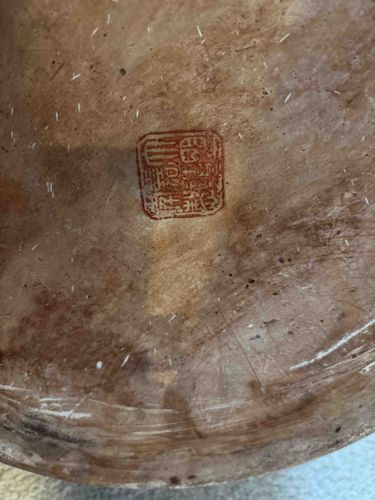
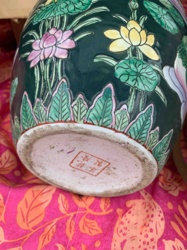
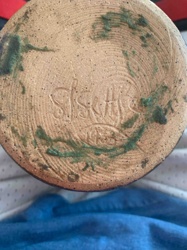
This item is the base of an old Chinese ceramic vase, primarily characterized by its unglazed, earthy-toned stoneware or pottery material. The surface exhibits a rough, somewhat porous texture with varying shades of brown, tan, and grey, suggesting an unrefined firing process or considerable age and wear. The most prominent feature is a rectangular, red-stamped maker's mark or seal, centered on the base. This mark appears to contain intricate Chinese characters, indicative of the kiln, artist, or reign period during which the vase was produced. The characters are somewhat obscured by the texture of the ceramic and the slight smudging of the red pigment, but enough detail is visible to suggest a formal inscription. Circular scoring or concentric rings are visible on the base, likely remnants from the pottery wheel or the manufacturing process where the base was shaped and possibly cut. These marks also show areas of wear and discoloration, contributing to the aged appearance. There are several small, white 'flecks' scattered across the surface, which could be chips, mineral deposits, or remnants of a past adhesion. The overall condition suggests significant age with considerable wear and patina, but no obvious cracks or repairs are discernible from this view. The visible craftsmanship, particularly the clear, albeit aged, ceramic material and the precise application of the maker's mark, points to a period of traditional Chinese pottery making. The style period is not definitively determinable from this view alone but is consistent with various dynasties known for their ceramic production. The quality seems characteristic of functional or decorative stoneware, rather than fine porcelain, emphasizing durability and a rustic aesthetic.
AI Appraisal Report
I have carefully examined the provided image of the base of this Chinese ceramic vase, noted for its unglazed, earthy-toned stoneware. The surface exhibits a rough, porous texture, consistent with traditional, older firing processes and significant age. The most striking feature is the red-stamped maker's mark, which, despite some smudging and the ceramic's texture, clearly shows intricate Chinese characters. These marks are crucial for identification but are not fully decipherable from the image alone. The concentric rings suggest traditional pottery wheel work, and the wear and discoloration are in line with considerable age, indicating an authentic antique piece. The small white flecks appear to be minor chips or mineral deposits rather than major damage. No obvious cracks or repairs are visible, which is positive for its structural integrity.
At present, without a clear reading of the maker's mark and without a view of the entire vase, definitive authentication of the specific maker or dynasty is impossible. The market for unglazed, utilitarian Chinese stoneware, while stable, does not command the high prices of finely decorated porcelain unless it is attributed to a highly celebrated kiln or artist. Similar unglazed stoneware pieces with clear but undeciphered marks typically fetch modest prices. Rarity is difficult to assess without full identification; many such pieces were produced. Demand tends to be niche, appealing to collectors who appreciate rustic aesthetics and historical pottery.
Factors impacting value positively include its apparent substantial age and the presence of a clear maker's mark. Negatively, the lack of glaze, the utilitarian aesthetic, and the obscured mark limit its current appraised value. To fully authenticate this piece and determine its precise value, I would require an in-person examination to decipher the maker's mark accurately, assess the entire vase's form and decoration, and potentially conduct scientific dating or material analysis. Provenance documentation, if available, would also significantly enhance its value.