These notes were written by the person who submitted this item. Appraiser.AI has not verified them, and the AI's identification and estimate may rely on them.
AI Estimated Value
Not an official valuation
$40-70
AI estimate as of October 2, 2025 · verify with a professional before acting
AI-Generated · Verify before acting
Everything on this page is generated by AI for informational purposes only. AI can make mistakes — the AI may misidentify items or misattribute them (artist, maker, brand, designer, origin, era). This is not an official valuation and should not be used for insurance, sale, tax, estate, legal, or lending purposes — or any decision requiring a certified appraisal. It is not an authoritative claim about any person, brand, or rights holder — do not share or rely on it as a factual statement about a third party. Always consult qualified professionals before making financial decisions.
This analysis also relies on unverified notes provided by the user, which may be incomplete or inaccurate and could affect the result.
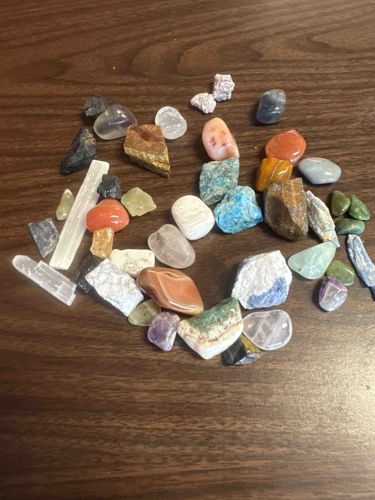
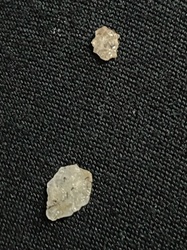
This item is a collection of approximately 40 to 50 individual natural gemstones and minerals, presented in both tumbled (polished) and raw (natural) forms. The collection displays a wide variety of colors, textures, and translucencies, indicative of different mineral compositions. Sizes range from small pebble-like pieces, roughly 0.5 cm in diameter, to larger irregular chunks, approximately 3-4 cm in length or width. Predominant colors include various shades of white, clear, grey, black, brown, orange, red, green, blue, and purple.
Observable materials include what appears to be selenite in elongated, crystalline forms; carnelian or red jasper in vibrant orange and red tumbled pieces; tiger's eye with its characteristic chatoyant bands; various forms of quartz (clear, milky, rose, and possibly amethyst for the purple pieces); aventurine or jade in green hues; lapis lazuli or sodalite in blue, sometimes mixed with white streaks; and other unidentified minerals in a range of earth tones. Most of the tumbled stones exhibit a smooth, polished surface with a waxy to vitreous luster, indicating a mechanical polishing process. The raw pieces retain their natural crystalline structures, fractures, and rough textures. Some pieces show visible internal inclusions, cloudiness, or banding patterns that are characteristic of natural stone formations. There are no obvious signs of significant damage such as large chips or cracks that would diminish their aesthetic appeal, though minor natural imperfections or unpolished edges are present on some raw specimens. The overall condition suggests a well-maintained collection, likely intended for display, spiritual practices, or as craft materials. No specific maker's marks or signatures are discernible, as is typical for natural, unworked mineral specimens. Based on their appearance, these stones are likely contemporary and could have been collected or purchased anytime within the last few decades, with no distinct historical style period applicable beyond 'natural raw/tumbled stone'. The craftsmanship, where applicable to tumbling, appears to be of good commercial quality, achieving a smooth finish for the individual stones.
AI Appraisal Report
I have examined this collection of approximately 40-50 assorted tumbled and raw gemstones and minerals. The condition appears to be very good, with smooth, polished surfaces on the tumbled stones and natural, unblemished textures on the raw specimens. Authenticity is supported by the visible natural inclusions, banding, and crystalline structures typical of genuine minerals. However, without direct tactile examination and specific gravity tests, definitive identification of some specific varieties (e.g., distinguishing lapis lazuli from sodalite, or Aventurine from Jade) is limited. The craftsmanship for the tumbled pieces is good commercial quality.
Market conditions for such mixed collections are generally stable, driven by hobbyists, spiritual practitioners, and DIY crafters. Comparable items, often sold in bulk lots, typically fetch modest prices. While the variety is appealing, no singularly rare or high-value specimens are immediately apparent from the description. Demand is consistent but not high-volume for individual collections of this nature. The primary factor impacting value is the sheer number and variety, rather than the intrinsic value of any single stone.
For full authentication and precise identification of each mineral, an in-person examination, including hardness testing, specific gravity measurements, and potentially spectroscopic analysis, would be necessary. Provenance documentation, detailing the source of the stones, would also enhance certainty. Based on the provided details, this is a charming, entry-level collection that holds a utilitarian and aesthetic rather than a high intrinsic monetary value.