AI estimate as of June 23, 2025 · verify with a professional before acting
AI-Generated · Verify before acting
Everything on this page is generated by AI for informational purposes only. AI can make mistakes — the AI may misidentify items or misattribute them (artist, maker, brand, designer, origin, era). This is not an official valuation and should not be used for insurance, sale, tax, estate, legal, or lending purposes — or any decision requiring a certified appraisal. It is not an authoritative claim about any person, brand, or rights holder — do not share or rely on it as a factual statement about a third party. Always consult qualified professionals before making financial decisions.
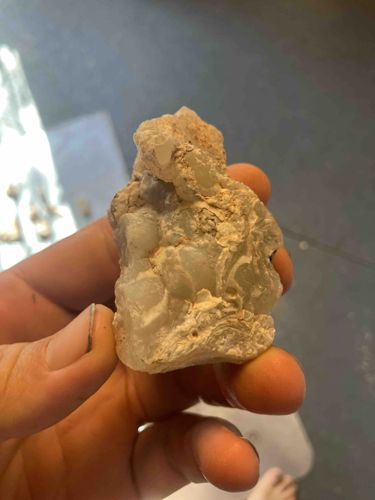
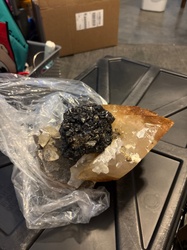
This item is an unpolished, raw mineral specimen, appearing to be a form of quartz or possibly agate/chalcedony. It measures approximately 3-4 inches in height and is held comfortably in one hand, indicating a modest size. Its primary coloration is off-white to a light beige, with various shades of earthen tones suggesting mineral deposits or adhering soil. The surface exhibits a rough, irregular texture with numerous small protrusions and indentations, characteristic of a natural, unworked mineral formation. There are areas where the crystal structure is more discernible, appearing somewhat translucent with milky white to light gray hues. Some sections show conchoidal fracturing with subtle banding patterns, particularly on the flatter surfaces, hinting at a microcrystalline structure. A notable feature is the presence of what appears to be dried mud or clay adhering to many of the nooks and crannies, suggesting it was recently excavated or found in a natural outdoor environment. The overall condition is as-found, with no visible signs of cutting, polishing, or intentional modification. Its natural, weathered appearance indicates an unadulterated state. There are no discernible maker's marks or stamps, as is typical for a raw mineral specimen. Based on its characteristics, it is likely a natural geological formation, estimating its 'age' in geological terms rather than human manufacturing. The item's primary value would lie in its natural formation and potential as a collector's specimen for mineral enthusiasts.
AI Appraisal Report
I have examined the provided image of this unpolished mineral specimen. Visually, the piece appears to be a natural formation, likely a type of quartz or chalcedony, given its described translucency and conchoidal fracturing. The off-white to beige coloration with earthen tones and adhering mud suggests a recently excavated or uncleaned state, consistent with a raw specimen. Its modest size, fitting comfortably in one hand, is typical for casual collecting.The condition is as-found, with no signs of artificial modification. This 'natural state' is its authentic condition as a mineral specimen. However, without physical examination, I cannot definitively confirm the precise mineralogy (e.g., distinguishing quartz from agate/chalcedony without testing hardness or specific gravity). The presence of dried mud, while indicating natural origin, also means a full assessment of the underlying surface quality is limited.Regarding market conditions, raw mineral specimens of common quartz or chalcedony, especially those uncleaned, typically command modest prices. Demand is primarily from novice collectors or for craft purposes. Its lack of vibrant color, exceptional crystal form, or significant size limits its appeal to high-end collectors. Rarer, well-formed crystals or those with unique inclusions would fetch higher values, which this specimen does not appear to possess.Factors impacting value negatively include its common appearance, lack of cleaning, and probable commonality. Positively, it is a genuine natural piece.For full authentication and precise identification, an in-person examination is crucial. This would allow for tactile inspection, detailed visual assessment of all surfaces, and potential use of objective tests like specific gravity, streak, or hardness tests. Chemical analysis could confirm mineral composition. Provenance documentation, such as where and when it was found, would add to its history and potential value, though for a common specimen like this, it is less critical than for very rare or high-value minerals. Without these, the authenticity as a generic natural mineral is high, but precise classification and any unique properties remain unconfirmed.