AI Appraisal Estimate

AI-generated estimates · not official valuations

From the user

What was submitted

Photo and notes provided by the user — not generated by AI

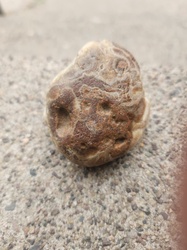
Submitted item photo
Submitted photo · May 19, 2026

User's notes

No additional notes provided.

AI analysis below

AI appraisal

AI analysis & estimate

AI-Generated · Verify before acting

Everything below is generated by AI for informational purposes only. AI can make mistakes — the AI may misidentify items or misattribute them (artist, maker, brand, designer, origin, era). This is not an official valuation and should not be used for insurance, sale, tax, estate, legal, or lending purposes — or any decision requiring a certified appraisal. It is not an authoritative claim about any person, brand, or rights holder — do not share or rely on it as a factual statement about a third party. Always consult qualified professionals before making financial decisions.

Read the full disclaimer

AI Identification

·Not independently authenticated·Verify before acting

Polished Natural Teal and White Mineral Specimen

Minerals & Lapidary Arts

AI Estimated Value

·Not an official valuation·Verify before acting

$450 - $600

As of May 19, 2026

AI Item Analysis

·AI can make mistakes·Verify before acting
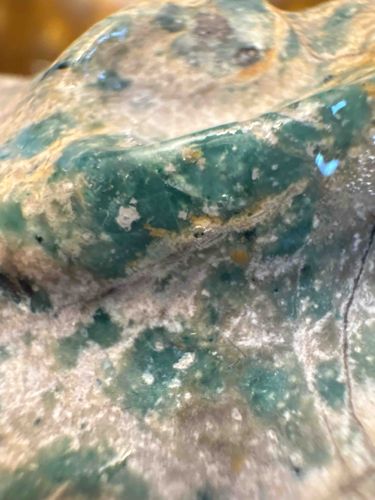
This item is a natural mineral specimen featuring a striking color palette of deep teal-green and mottled off-white to pale grey. The material appears to be a form of silicate mineral, possibly a variety of ocean jasper or chrysocolla-dominant stone, characterized by its botryoidal or orbicular texture visible in the darker regions. The surface has been professionally polished to a high-gloss finish, which enhances the depth of the teal hues and creates sharp light reflections across the undulating geometry of the piece. The interior matrix shows a granular, crystalline structure with fine white specks scattered throughout the green zones. Notably, the specimen exhibits natural fissures and internal fracture lines, which are common in these types of geological formations and do not necessarily indicate damage but rather natural growth history. There are subtle yellow-brown inclusions or ocreous patches visible beneath the surface, adding to the complexity of the piece. The construction is entirely natural with no visible adhesives or composite repairs. While of indeterminate age geologically, the lapidary work shows modern high-quality craftsmanship, evidenced by the smoothness of the curves and the lack of visible grinding marks. The irregular, organic shape suggests it may have been tumbled or free-form carved to follow the natural deposition of the minerals.
AI Appraisal Report

·AI can make mistakes·Verify before acting
I have conducted a visual examination of the polished teal and white mineral specimen, which appears to be a high-quality variety of Chrysocolla in Quartz or a similar silicate matrix like Ocean Jasper. The specimen displays exceptional saturation in its teal-green hues and a professional lapidary finish that maximizes its orbicular and botryoidal patterns. The condition is excellent for a natural specimen; while internal fissures and micro-fractures are visible, they are consistent with the geological formation of these minerals and do not detract from the structural integrity or aesthetic appeal of the piece. Market demand for high-contrast, free-form mineral specimens remains strong among collectors of lapidary arts and interior design professionals. Comparables for specimens of this size and saturation typically fall in the mid-hundreds, with premiums paid for pieces showing distinct color separation and high-gloss finishes. The primary value drivers here are the depth of the teal coloration and the quality of the polish. Limitations: This appraisal is based solely on digital imagery. A definitive identification of the mineral species—specifically differentiating between Chrysocolla, Variscitite, or complex Jasp-agates—would require in-person Mohs scale hardness testing and possibly RAMAN spectroscopy. Furthermore, a physical inspection is necessary to ensure the 'gloss' is not a resin coating and to confirm the absence of stabilizers or artificial dyes often found in the current market. Provenance regarding the specific mine of origin would further refine this valuation.

Get your items appraised

Instant estimates of your treasures with AI-powered appraisals

Browse More Appraisals