AI estimate as of September 7, 2025 · verify with a professional before acting
AI-Generated · Verify before acting
Everything on this page is generated by AI for informational purposes only. AI can make mistakes — the AI may misidentify items or misattribute them (artist, maker, brand, designer, origin, era). This is not an official valuation and should not be used for insurance, sale, tax, estate, legal, or lending purposes — or any decision requiring a certified appraisal. It is not an authoritative claim about any person, brand, or rights holder — do not share or rely on it as a factual statement about a third party. Always consult qualified professionals before making financial decisions.
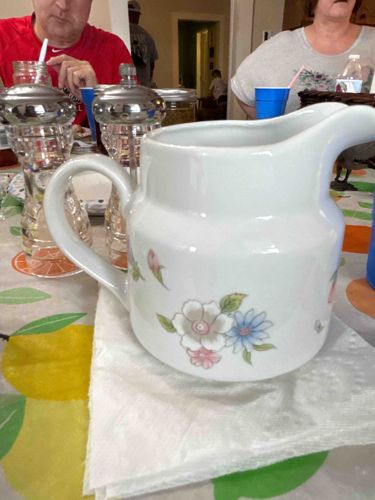
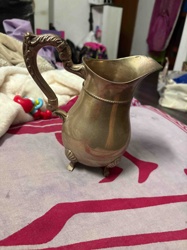
This is a ceramic pitcher, primarily white in color, featuring a decorative floral pattern. The pitcher has a classic form with a widened base that tapers upwards to a narrower neck and a flared pouring spout. A large, C-shaped handle is attached to one side of the body, appearing sturdy and well-integrated. The floral design consists of clusters of flowers in soft pastel tones, including shades of pink, blue, and off-white/grey, complemented by green leaves. These floral motifs appear distributed around the body of the pitcher, suggesting a repeating pattern. The surface of the ceramic appears glossy, indicating it is glazed. No obvious chips, cracks, or significant visible wear are apparent from the provided images, suggesting it is in good to excellent used condition, maintaining its original finish and decorative elements. The construction appears to be machine-made ceramic, typical of mass-produced dinnerware or serving pieces. There are no visible maker's marks or signatures in the provided views, which would typically be found on the base. Given the style of the floral decoration and the general form, it likely dates to the mid-to-late 20th century, possibly aligning with styles popular from the 1970s to 1990s. The craftsmanship suggests standard tableware quality, designed for functional everyday use rather than high artistic value.
AI Appraisal Report
Based on my visual examination of the provided image, this Floral Pattern Ceramic Pitcher appears to be in good to excellent used condition, with no visible chips, cracks, or significant wear. The glossy glaze and decorative elements are well-preserved. Its authenticity as a mass-produced ceramic pitcher from the mid-to-late 20th century, likely 1970s-1990s, is consistent with its style and apparent construction. Without physical inspection, I cannot confirm the absence of hairline cracks, crazing, or other minute imperfections that could affect value.
Market conditions for generalized, mass-produced ceramic tableware of this era are typically modest. Comparables often include similar pitchers found in thrift stores, antique malls, or online marketplaces specializing in vintage home goods. Demand for such items is generally low, driven primarily by aesthetic appeal for decorative use or basic functionality rather than collectible rarity. Factors significantly impacting value include the lack of a discernible maker's mark, indicating it's not from a highly sought-after manufacturer, and its common design, which doesn't present unique artistic merit or historical significance.
Limitations in authenticity verification from images alone are notable. A physical examination would allow me to inspect the base for maker's marks, feel the glaze for any imperfections, thoroughly check for any repairs, and assess its weight and overall craftsmanship more accurately. Provenance documentation, such as original sales receipts or manufacturing details, would be necessary for full authentication of its origin or specific manufacturing date, though for an item of this type, such documentation is rarely available or necessary for valuation. Scientific testing is not applicable here as it concerns material composition rather than authenticity for this type of item.