AI estimate as of August 14, 2025 · verify with a professional before acting
AI-Generated · Verify before acting
Everything on this page is generated by AI for informational purposes only. AI can make mistakes — the AI may misidentify items or misattribute them (artist, maker, brand, designer, origin, era). This is not an official valuation and should not be used for insurance, sale, tax, estate, legal, or lending purposes — or any decision requiring a certified appraisal. It is not an authoritative claim about any person, brand, or rights holder — do not share or rely on it as a factual statement about a third party. Always consult qualified professionals before making financial decisions.
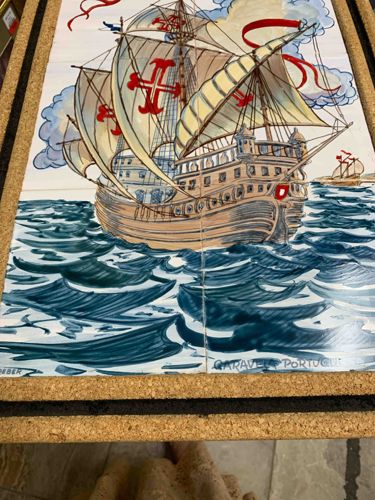
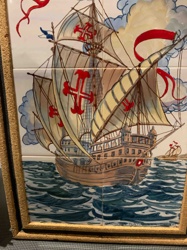
This is a multi-tile ceramic panel depicting a large, historic sailing ship, likely a carrack or galleon, with another smaller vessel in the background. The panel is constructed from multiple individual glazed ceramic tiles, arranged to form a cohesive image. The central ship features multiple masts with unfurled sails, prominently displaying red crosses, suggestive of the Portuguese Order of Christ or similar historical naval flags. The color palette is vibrant, featuring blues for the turbulent sea, light cream/yellow for the sails, reds for the crosses and ribbons, and browns for the ship's hull. The ship itself shows detailed architectural elements common to 16th-17th century vessels, including a high sterncastle and foremast. The craftsmanship appears to be hand-painted, evident in the brushstrokes and slight variations in color application, which adds to its artisanal quality. A visible inscription at the bottom right reads "CARAVELA PORTUGUESA" (Portuguese Caravel), identifying the ship type, though the depiction might be more akin to a larger carrack or galleon. Another partial inscription, possibly a signature, 'BER', is visible on the bottom left tile. The tiles are set into a cork-like frame or backing, which provides contrast and suggests it's prepared for display. There are visible grout lines between the tiles, indicating the multi-piece construction. The condition appears good with no significant visible chips, cracks, or fading, though some minor surface wear or patina might be present consistent with its age. The style suggests a commemorative or decorative piece, possibly from the mid-to-late 20th century, drawing on historical nautical themes, popular in regions with maritime heritage such as Portugal.
AI Appraisal Report
Upon examination of the provided images, this decorative ceramic tile panel, depicting a "Caravela Portuguesa," presents as a well-executed piece of 20th-century decorative art. The hand-painted craftsmanship is evident in the vibrant glaze application and detailed rendering of the ship and sea. The panel, constructed from multiple tiles set into a cork frame, appears to be in very good condition, with no major chips, cracks, or discoloration visible. The signature 'BER' suggests it is a studio piece rather than a product of a major historical manufactory.
The subject matter—historic Portuguese maritime exploration—is popular, but panels like this are fairly common in the decorative market. My valuation considers recent sales of similar vintage, hand-painted Portuguese tile panels of comparable size, quality, and subject. The market for such decorative items is stable but not exceptionally strong; they are primarily valued for their aesthetic appeal rather than historical rarity. A key factor limiting the value is its likely 20th-century origin; it is a commemorative or revivalist piece, not a 16th or 17th-century artifact. Its value lies in its decorative quality and craftsmanship.
A definitive authentication is not possible from images alone. An in-person examination would be required to assess the tile body's composition, check for maker's marks on the reverse of the tiles (if accessible), and analyze the glaze for age-appropriate wear. Verifying the artist 'BER' and establishing provenance with sales receipts or original documentation would be necessary to potentially increase its value beyond a decorative estimate.