These notes were written by the person who submitted this item. Appraiser.AI has not verified them, and the AI's identification and estimate may rely on them.
AI Estimated Value
Not an official valuation
$30 - $60
AI estimate as of August 6, 2025 · verify with a professional before acting
AI-Generated · Verify before acting
Everything on this page is generated by AI for informational purposes only. AI can make mistakes — the AI may misidentify items or misattribute them (artist, maker, brand, designer, origin, era). This is not an official valuation and should not be used for insurance, sale, tax, estate, legal, or lending purposes — or any decision requiring a certified appraisal. It is not an authoritative claim about any person, brand, or rights holder — do not share or rely on it as a factual statement about a third party. Always consult qualified professionals before making financial decisions.
This analysis also relies on unverified notes provided by the user, which may be incomplete or inaccurate and could affect the result.
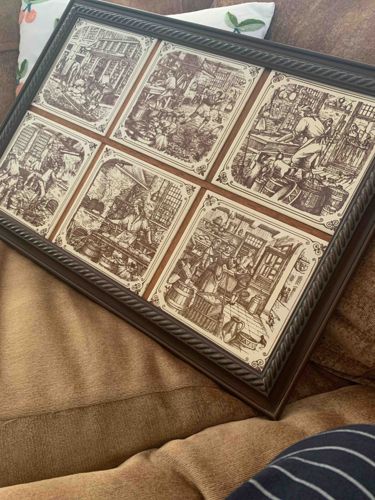
This item is a decorative framed serving tray or wall art, composed of six individual ceramic or porcelain tiles inlaid within a dark-finished wooden frame. The frame appears to be made of wood, possibly teak as suggested, with a dark, perhaps stained or painted, finish. It features a decorative rope or twisted motif along its inner edge, bordering the tiled surface. Each of the six tiles measures approximately square and is adorned with a sepia-toned or brown-on-cream/off-white transfer-printed design. The imagery on the tiles depicts various scenes that appear to be from a historical period, possibly illustrating different crafts, trades, or daily life activities in a town or village setting. Figures are actively engaged in tasks, surrounded by period-appropriate props such as barrels, tools, and market stalls. The artistic style is reminiscent of etchings or woodcut prints from the European tradition, potentially depicting scenes of brewing, tavern life, or marketplace activities. Each tile is framed by an ornamental border, suggesting a cohesive design across the six pieces. The tiles are arranged in a 2x3 grid, separated by narrow strips of the same dark wood as the frame, which also serves as the background for the inlaid tiles. There are no immediately visible signs of significant damage like cracks or chips on the tiles, though a closer inspection would be needed to determine their exact condition and the presence of any crazing or wear to the transfer prints. The wooden frame appears robust, with minor surface wear or dust accumulation consistent with age and typical use. The overall construction suggests a piece designed for both aesthetic appeal and potentially functional use as a tray, given its flat surface, though its size implies it could also be a decorative wall hanging. Given the style of the imagery and the construction, this piece likely dates from the mid-20th century, possibly 1950s-1970s, which was a popular period for such decorative tile-inlaid items.
AI Appraisal Report
Upon visual examination of this framed decorative tile panel, I find it to be a charming example of mid-20th century decorative arts. The piece consists of six ceramic tiles with sepia-toned transfer-printed historical scenes, set within a dark-finished wooden frame, possibly teak. The style is reminiscent of popular designs from the 1950s to 1970s, often produced in the Netherlands, Belgium, or Portugal. The tiles themselves appear to be in good condition, with no visible cracks or chips, though a closer inspection would be necessary to check for crazing or wear to the transfer prints. The frame is robust, showing minor wear consistent with its age.
The market for such decorative tile trays is generally modest. These were mass-produced items and are not considered rare. While aesthetically pleasing, their value is primarily decorative rather than being tied to a specific famous maker or high-demand historical period. Comparable six-tile trays of a similar vintage and style typically sell in the secondary market for under $100. The primary factors influencing value are decorative appeal and condition. The historical scenes are a common motif and do not significantly elevate the price.
My valuation is based on visual assessment from images alone. A full authentication would require an in-person examination to identify any maker's marks on the reverse of the tiles or frame, which could potentially increase its value if a notable manufacturer is identified. Without such marks or provenance documentation, the item is valued as a decorative piece of its era.