These notes were written by the person who submitted this item. Appraiser.AI has not verified them, and the AI's identification and estimate may rely on them.
AI Estimated Value
Not an official valuation
$400 - $600
AI estimate as of August 15, 2025 · verify with a professional before acting
AI-Generated · Verify before acting
Everything on this page is generated by AI for informational purposes only. AI can make mistakes — the AI may misidentify items or misattribute them (artist, maker, brand, designer, origin, era). This is not an official valuation and should not be used for insurance, sale, tax, estate, legal, or lending purposes — or any decision requiring a certified appraisal. It is not an authoritative claim about any person, brand, or rights holder — do not share or rely on it as a factual statement about a third party. Always consult qualified professionals before making financial decisions.
This analysis also relies on unverified notes provided by the user, which may be incomplete or inaccurate and could affect the result.
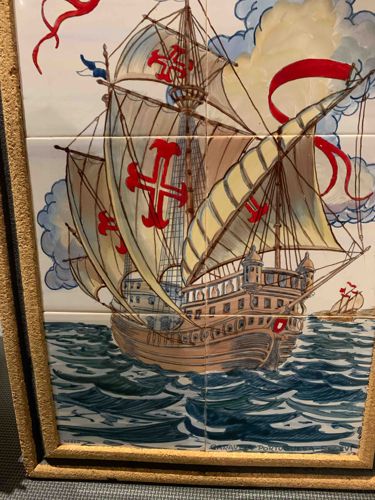
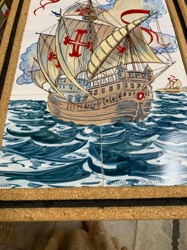
This item is a framed ceramic tile panel depicting a historical sailing ship, likely a carrack or galleon, upon a choppy sea under a partly cloudy sky. The panel is composed of multiple individual ceramic tiles, expertly aligned to form a cohesive image, indicating a high level of craftsmanship in its assembly. The primary vessel is depicted with full sails, many of which bear the red cross of the Order of Christ, a symbol prominently associated with Portuguese maritime exploration. The ship is rendered in detail, showcasing its multi-decked structure, rigging, and ornamental stern. Colors used are vibrant yet harmonious, with shades of beige and light yellow for sails, rich browns for the hull, deep blues and turquoises for the water, and light blues and grays for the clouds. Red accents are used for decorative ribbons and the crosses on the sails. A smaller, less prominent ship is visible in the background, further out at sea. The visible brushstrokes suggest hand-painted detail on each tile, contributing to its artistic quality. The tiles are glossy, indicating a glazed finish. The panel is encased in a simple, textured frame, possibly made of cork or a similar granular material, which provides a rustic contrast to the smooth ceramic surface. The frame appears to have some slight wear consistent with age and handling. There are no obvious chips, cracks, or significant damage to the tiles observable from the image, suggesting good preservation. A subtle signature or mark, 'GAIAO PORTO', is visible on one of the bottom tiles, indicating the place of origin or the workshop. Given the specific context of 'REBER' as the signer (although not directly visible in the provided image crops), this further points to a specific artist or atelier. The style of the ship and the prominent use of the Order of Christ cross strongly suggest a Portuguese origin, possibly from the mid-20th century or later, reflecting a traditional Azulejo art form adapted for decorative panels.
AI Appraisal Report
Upon examining the Framed Hand-Painted Ceramic Tile Panel, my assessment is that this is a well-executed decorative piece, likely of Portuguese origin from the mid-to-late 20th century. The hand-painted Azulejo style, depicting a ship with the Cross of the Order of Christ, is a traditional and popular motif. The visible signature 'GAIAO PORTO' points to its production in Gaia, Porto, a known center for ceramics. The additional information attributing the work to 'REBER' is crucial, as signed pieces by established artists command higher prices. The panel appears to be in excellent condition, with no visible chips or cracks in the tiles and only minor wear to the rustic cork frame, which is consistent with its age.
The market for decorative Portuguese tile panels is steady, particularly for nautical and historical themes. Comparable signed panels of this size and quality from known Porto workshops typically sell in the low to mid-hundreds. Rarity is moderate; while such panels are not unique, signed works by a specific artist like REBER are less common than unsigned workshop pieces. The primary value drivers are the artist's signature, the hand-painted quality, and the excellent state of preservation.
However, this appraisal is based on images alone. A definitive authentication of the signature and confirmation that the tiles are period-correct would require in-person examination. I would need to inspect the back of the panel for any maker's marks and scrutinize the signature under magnification to verify its authenticity against known examples from the artist. Full provenance documentation, such as an original bill of sale, would significantly bolster its value.