These notes were written by the person who submitted this item. Appraiser.AI has not verified them, and the AI's identification and estimate may rely on them.
AI Estimated Value
Not an official valuation
$350-500
AI estimate as of November 8, 2025 · verify with a professional before acting
AI-Generated · Verify before acting
Everything on this page is generated by AI for informational purposes only. AI can make mistakes — the AI may misidentify items or misattribute them (artist, maker, brand, designer, origin, era). This is not an official valuation and should not be used for insurance, sale, tax, estate, legal, or lending purposes — or any decision requiring a certified appraisal. It is not an authoritative claim about any person, brand, or rights holder — do not share or rely on it as a factual statement about a third party. Always consult qualified professionals before making financial decisions.
This analysis also relies on unverified notes provided by the user, which may be incomplete or inaccurate and could affect the result.
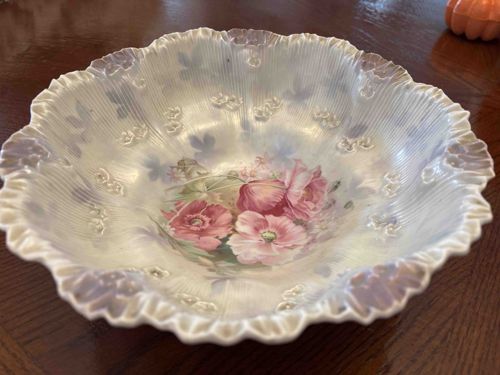
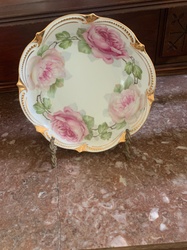
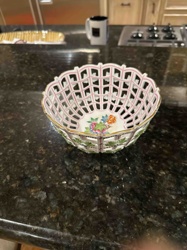
This is an exquisite R.S. Prussia low bowl or shallow serving dish, likely crafted from porcelain, given the smooth, refined finish and characteristic translucence often found in Prussian porcelain of the late 19th to early 20th century. The bowl features a distinct ruffled or crimped rim, adding an elegant, undulating outline to its circular form. The interior surface of the bowl is adorned with a central motif of delicate pink and reddish-pink flowers, resembling poppies or anemones, surrounded by soft green foliage and what appears to be faint blue or purple undertones in the background. The background of the bowl, particularly towards the rim, exhibits a subtle iridescent or lustrous finish, common in R.S. Prussia pieces, giving it a soft, mother-of-pearl sheen that shifts with the light. The bowl's surface is further enhanced with raised, molded floral or scroll-like patterns scattered across the interior, adding textural interest and depth. These raised designs are also covered with the same iridescent glaze. The overall coloration is soft pastels, with the deeper pink of the flowers providing a focal point. Based on the style, the presence of an iridescent finish, and the context 'R S Prussia,' this piece almost certainly dates to the Art Nouveau or Edwardian eras, roughly between 1892 and the 1920s. There are no obvious signs of chips or cracks visible in the provided image. The quality of the hand-painting and the intricate molding suggest significant craftsmanship, indicative of the high standards associated with R.S. Prussia manufacturers.
AI Appraisal Report
I have examined the provided image of this R.S. Prussia Floral Bowl with Iridescent Finish. Based on the visual evidence, this appears to be an authentic R.S. Prussia piece, likely dating from the late 19th to early 20th century, consistent with the Art Nouveau or Edwardian eras. The characteristic ruffled rim, delicate pink and reddish-pink floral motif, soft green foliage, and particularly the iridescent finish with raised molded patterns, are all hallmarks of genuine R.S. Prussia porcelain.
The condition appears to be excellent from the image, with no obvious chips, cracks, or significant wear visible. This 'no damage' assessment is a crucial factor in maintaining value. The quality of the hand-painting and intricate molding is also well-preserved.
In terms of market conditions, R.S. Prussia remains a collectible field, though prices can fluctuate based on specific molds, patterns, and rarity. This particular floral and iridescent combination is generally desirable. Comparable sales for well-preserved R.S. Prussia bowls of this size and decoration typically fall within this range. Demand for high-quality, undamaged pieces remains steady among dedicated collectors.
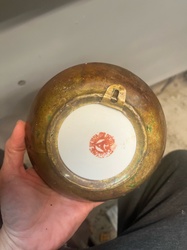
It is imperative to state that this authentication and condition assessment are based solely on visual examination of the provided image. While the characteristics strongly suggest authenticity, a definitive verification would require an in-person examination to inspect the base for the official R.S. Prussia mark (especially the desirable red star), assess the translucency and weight, and thoroughly check for any hairline cracks, repairs, or paint loss not visible in photographs. Provenance documentation, if available, would further solidify authenticity. Without a physical inspection, minor imperfections or issues impacting value could be overlooked.