AI estimate as of August 9, 2025 · verify with a professional before acting
AI-Generated · Verify before acting
Everything on this page is generated by AI for informational purposes only. AI can make mistakes — the AI may misidentify items or misattribute them (artist, maker, brand, designer, origin, era). This is not an official valuation and should not be used for insurance, sale, tax, estate, legal, or lending purposes — or any decision requiring a certified appraisal. It is not an authoritative claim about any person, brand, or rights holder — do not share or rely on it as a factual statement about a third party. Always consult qualified professionals before making financial decisions.
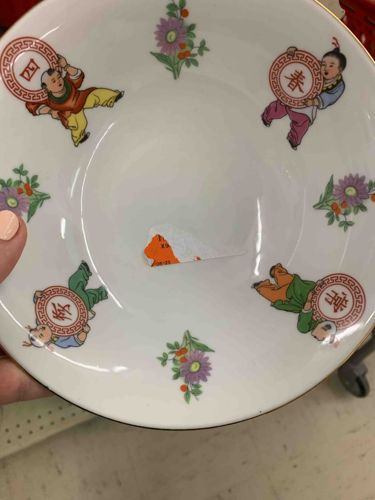
This appears to be a porcelain or fine ceramic bowl, likely part of a dinnerware set or a decorative serving piece. The primary color is a glossy white, with intricate polychrome decoration. The design features four stylized figures of children, often referred to as 'boys' or 'fu babies,' each holding a circular medallion with a Chinese character inscribed within. The medallions are bordered with a classic Chinese 'leiwen' or meander pattern in red. The figures are rendered in lively postures with vibrant clothing in shades of orange, yellow, green, light blue, and pink. Scattered between the children are clusters of floral motifs, featuring purple daisy-like flowers with orange centers, green leaves, and small red berries, adding to the decorative appeal. The rim of the bowl has a thin, elegant gold-colored band, suggesting a touch of refinement and quality. There is an orange sticker visible near the center of the bowl, likely a price tag from a retail or thrift store, which obstructs a small part of the central area. The bowl exhibits a smooth, reflective surface, indicative of well-fired and glazed ceramic. The condition appears good overall, with no immediately visible chips, cracks, or significant wear to the glaze or painted design, aside from the adhesive residue from the sticker. The craftsmanship is evident in the detailed illustration and crisp lines of the painted elements, suggesting a factory-produced item, possibly from the mid-20th century or later, designed for everyday use or decorative display with cultural motifs.
AI Appraisal Report
This Chinese Porcelain 'Fu Baby' Decorative Bowl, based on my visual examination, appears to be in good overall condition. The glossy white ceramic body shows no immediately visible chips, cracks, or significant wear to the glaze or painted decoration, aside from the adhesive residue from a likely modern price sticker. The vibrant polychrome "fu baby" figures and floral motifs are characteristic of decorative Chinese porcelain produced from the mid-20th century onwards, often for export. The presence of a thin gold band on the rim and detailed hand-painted elements suggest a level of quality above mass-produced utilitarian wares.
From images alone, assessing authenticity for age and origin is limited. While the style is traditional, specific hallmarks or a maker's mark are not visible, which would be crucial for precise dating and attribution. Without a physical examination, I cannot verify the type of porcelain (e.g., bone china, feldspathic porcelain) or glaze quality. Removal of the sticker would be necessary to check for any damage or marks underneath. The demand for such decorative pieces is moderate, primarily from collectors of Asian art or individuals seeking ornamental items with a cultural theme. This is not a rare item in the broader market.
To fully authenticate and confirm the age, an in-person examination would be required to inspect the paste, glaze, and firing imperfections; identify any maker's marks on the base; and potentially conduct scientific testing such as thermoluminescence dating if significant age is suspected. Provenance documentation, such as original sales receipts or family history, would also immensely aid in valuation. Given the typical market for similar decorative items, the value is primarily aesthetic and decorative rather than historical or antiquity-driven. The sticker's presence, while easily removable, temporarily detracts slightly from display.