AI estimate as of October 17, 2025 · verify with a professional before acting
AI-Generated · Verify before acting
Everything on this page is generated by AI for informational purposes only. AI can make mistakes — the AI may misidentify items or misattribute them (artist, maker, brand, designer, origin, era). This is not an official valuation and should not be used for insurance, sale, tax, estate, legal, or lending purposes — or any decision requiring a certified appraisal. It is not an authoritative claim about any person, brand, or rights holder — do not share or rely on it as a factual statement about a third party. Always consult qualified professionals before making financial decisions.
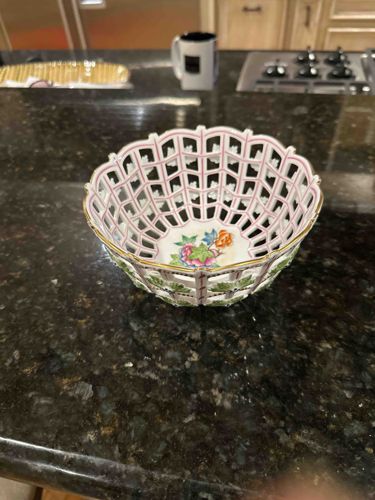
This is a small, ornate porcelain basket bowl, likely intended as a decorative accent or perhaps for serving small confections. The primary characteristic is its intricate reticulated or 'pierced' design, forming a lattice-like pattern around the sides. The porcelain appears to be fine quality, with a smooth, glazed finish. The dominant colors in the lattice work are white and a delicate pinkish-lavender, with some sections also showing green floral or leaf patterns. The rim of the bowl, bordering the openwork, is adorned with a thin band of gilt (gold) decoration, indicating a touch of luxury. The base of the bowl features a hand-painted floral motif, with prominent colors including a vibrant orange blossom, a multi-hued pink and green flower, and hints of blue and yellow, all surrounded by green foliage. The painting style suggests a traditional European aesthetic, possibly Meissen-inspired or similar Dresden-style porcelain, though without a visible maker's mark, this is speculative. The overall shape is round with slightly flaring sides. The craftsmanship appears to be quite high, given the complexity of the reticulated work and the detailed hand-painting. There are no obvious signs of significant damage such as chips, cracks, or repairs visible from this angle, and the gilt edge seems intact, suggesting good preservation or careful handling. The item likely dates from the late 19th to mid-20th century, a period known for such decorative porcelain pieces. Its small size, delicate nature, and decorative features indicate it was designed for aesthetic appeal rather than heavy utility.
AI Appraisal Report
Upon examining the images of this reticulated porcelain basket bowl, I assess it to be a decorative piece likely of European origin, dating from the late 19th to mid-20th century. The craftsmanship, evident in the pierced lattice work and hand-painted floral motif, is of good quality. The gilt rim appears intact, and I see no obvious chips, cracks, or repairs, suggesting the item is in excellent condition, which is a primary value driver for delicate porcelain. Its style is reminiscent of Dresden or Meissen, but the lack of a visible maker's mark prevents a definitive attribution to a major manufactory. Without a specific maker's mark, the bowl falls into the category of 'Dresden-style' or 'German porcelain,' which is highly decorative but commands a lower price than marked pieces from renowned factories like Meissen or KPM.
The current market for this type of decorative porcelain is stable but modest. While finely executed, these unmarked baskets are not exceptionally rare. Demand is steady among collectors of traditional European ceramics. Similar unmarked, hand-painted reticulated bowls of this size and condition typically sell in the secondary market for under $150.
It is crucial to note that this appraisal is based solely on images. A physical, in-person examination is required to fully authenticate the piece. This would involve inspecting for a maker's mark under magnification (sometimes faint or under the glaze), using a blacklight to check for hidden repairs, and confirming the age and origin of the porcelain body and glazes. Full authentication and a higher valuation would depend on identifying a specific, high-value maker.