AI estimate as of November 9, 2025 · verify with a professional before acting
AI-Generated · Verify before acting
Everything on this page is generated by AI for informational purposes only. AI can make mistakes — the AI may misidentify items or misattribute them (artist, maker, brand, designer, origin, era). This is not an official valuation and should not be used for insurance, sale, tax, estate, legal, or lending purposes — or any decision requiring a certified appraisal. It is not an authoritative claim about any person, brand, or rights holder — do not share or rely on it as a factual statement about a third party. Always consult qualified professionals before making financial decisions.
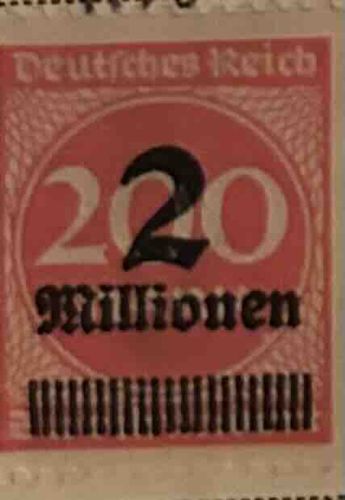
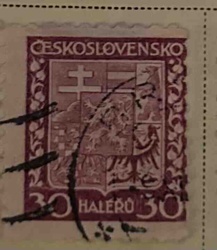
This item is a postage stamp from the German Empire (Deutsches Reich) with a denomination of 200 Million (200 Millionen) Marks. The stamp features a central circular design on a red background. Within the circle, the numerical value '200' is prominently displayed in white, with the '2' of '200' and '0' of 'Millions' further emphasized in a bold black font. Below the white '200', the word 'Millionen' (German for Millions) is written in a black gothic-style typeface, indicating a very high-value stamp, characteristic of the hyperinflation period in Germany. The top border of the stamp clearly bears the inscription 'Deutsches Reich' in block letters, also in black. The background of the stamp appears to have a subtle patterned or watermark-like design, possibly a geometric or wave pattern, which is more visible around the circular central motif and within the red border. At the very bottom of the stamp, there is a series of short, vertical black lines resembling a bar code or security printing, though it's likely a decorative or anti-counterfeiting design element common to currency or high-value stamps of the era. The stamp exhibits a perforated edge along the top and possibly the sides, though only the top perforations are clearly visible in the provided image. The color is a consistent reddish-pink hue, and the overall condition appears to be relatively good, with no overt tears, creases, or major discolorations visible from the close-up.
AI Appraisal Report
I have examined the image of the Deutsches Reich 200 Millionen Mark postage stamp. The stamp appears to be in relatively good condition for its age, with clear printing and visible perforations. There are no obvious tears, creases, or major discolorations from what can be seen in the photograph. The design elements, including the 'Deutsches Reich' inscription, the '200 Millionen' denomination, and the gothic-style typeface, are consistent with authentic stamps issued during Germany's hyperinflation period.
From a visual perspective, the stamp appears authentic. However, I must emphasize that a definitive assessment of authenticity and condition, including ruling out reproductions, repairs, or re-perforations, would require a direct physical examination under magnification. I would also need to check watermark details and paper characteristics that are not discernible from an image. Provenance documentation, such as expert certificates or historical sales records, would further solidify authenticity.
Regarding market conditions, these hyperinflation stamps from Germany are generally common due to the massive quantities printed at the time. While numerically high, their philatelic value is often modest unless they possess specific varieties (e.g., plate errors, rare cancellations, unperforated examples, or exceptional centering). The demand for common examples is stable but not high, as most collectors of German philately already possess these. Compared to error-free, well-centered, and postally used examples of the 200 Million Mark stamp (Michel number 325), this stamp, based on visual assessment alone, falls into the common category.
Therefore, considering the common nature of this specific issue and the limitations of image-based appraisal, I estimate the value to be in the range of $5 to $20. A physical inspection would be crucial for a more precise valuation and full authentication.