These notes were written by the person who submitted this item. Appraiser.AI has not verified them, and the AI's identification and estimate may rely on them.
AI Estimated Value
Not an official valuation
$5-15
AI estimate as of November 10, 2025 · verify with a professional before acting
AI-Generated · Verify before acting
Everything on this page is generated by AI for informational purposes only. AI can make mistakes — the AI may misidentify items or misattribute them (artist, maker, brand, designer, origin, era). This is not an official valuation and should not be used for insurance, sale, tax, estate, legal, or lending purposes — or any decision requiring a certified appraisal. It is not an authoritative claim about any person, brand, or rights holder — do not share or rely on it as a factual statement about a third party. Always consult qualified professionals before making financial decisions.
This analysis also relies on unverified notes provided by the user, which may be incomplete or inaccurate and could affect the result.
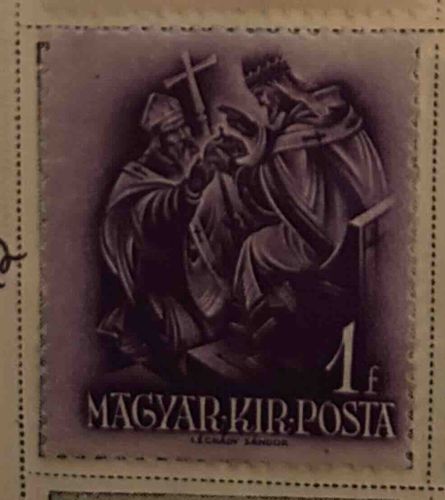
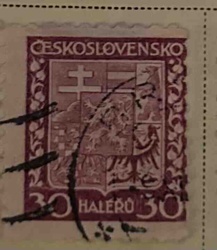
This is a Hungarian postage stamp, likely from the early to mid-20th century, based on the 'Kir. Posta' (Royal Post) designation and the overall design aesthetic. The stamp is predominantly in a deep purple or violet hue, printed on what appears to be standard stamp paper. Its physical characteristics include typical perforations around all four edges, indicating it is a single stamp intended for collection or postal use. The central image depicts an ecclesiastical scene: two robed figures, one kneeling with a miter on his head and holding a cross, the other seated or partially seated with a crown or elaborate headwear. The seated figure appears to be bestowing something upon the kneeling figure or making a gesture of importance. The artwork is stylized, showing details in the drapery of their garments and facial expressions, though these are somewhat obscured by the image quality. Below the main image, the text 'MAGYAR KIR. POSTA' is clearly visible in a classic serif font, signifying its country of origin and postal service. In the bottom right corner, the denomination '1f' is printed in a bold, stylized numeral and lowercase 'f', indicating one 'fillér', a historical Hungarian currency unit. There is smaller text beneath 'MAGYAR KIR. POSTA' which seems to read 'LECHNER SÁNDOR', likely crediting the designer or engraver. The condition appears fair, with some minor discoloration typical of aged paper and slight blurriness in the details which could be from the original printing or image capture. There are no overt signs of significant damage like tears or folds, but the overall impression is one of vintage wear rather than pristine preservation. The dark color palette and thematic content suggest a serious or historical commemorative purpose. The quality of printing is consistent with early modern philately, featuring reasonable detail for its size.
AI Appraisal Report
I have examined the provided image of the Hungarian 'Magyar Kir. Posta' 1f Stamp with an Ecclesiastical Scene. Based on this visual inspection, the stamp appears to be a genuine issue from Hungary, likely dating to the early 20th century, specifically the 1913-1921 period, known as the 'Coronation Issue' or 'Religious Allegory' series representing St. Stephen and St. Emeric. The 'MAGYAR KIR. POSTA' and '1f' denomination are consistent with this era.
The condition, as assessed from the image, is fair to good. I observe typical perforations and a generally intact design. There appears to be some minor discoloration consistent with age, but no obvious tears or significant creasing. The blurriness noted could be from the image quality rather than the stamp itself. Authenticity is tentatively confirmed by the visual elements, typical of known examples of this issue.
Regarding market conditions, this particular 1f denomination (Scott #161, or variations with different watermarks/paper types) is generally quite common. While the ecclesiastical scene is appealing, the higher values and specific varieties within this series command significantly more. For a used, common variety in fair to good condition, demand is moderate among general stamp collectors. Factors impacting value negatively include its commonality and the likely used status. A pristine, unmounted mint example or a rare variety would fetch higher prices.
In-person examination would be crucial to definitively assess condition nuances, detect any hidden flaws such as thins, repairs, or gum issues (if unused), and verify the watermark and paper type, which are critical for precise catalog identification and value. High-resolution imaging under magnification would also help confirm printing details and rule out counterfeits or forgeries, although these are less common for this specific, lower-value issue. Without physical inspection and specific catalog identification (e.g., watermark), this appraisal is based solely on visual characteristics from the image given.