These notes were written by the person who submitted this item. Appraiser.AI has not verified them, and the AI's identification and estimate may rely on them.
AI Estimated Value
Not an official valuation
$5 - $15
AI estimate as of November 10, 2025 · verify with a professional before acting
AI-Generated · Verify before acting
Everything on this page is generated by AI for informational purposes only. AI can make mistakes — the AI may misidentify items or misattribute them (artist, maker, brand, designer, origin, era). This is not an official valuation and should not be used for insurance, sale, tax, estate, legal, or lending purposes — or any decision requiring a certified appraisal. It is not an authoritative claim about any person, brand, or rights holder — do not share or rely on it as a factual statement about a third party. Always consult qualified professionals before making financial decisions.
This analysis also relies on unverified notes provided by the user, which may be incomplete or inaccurate and could affect the result.
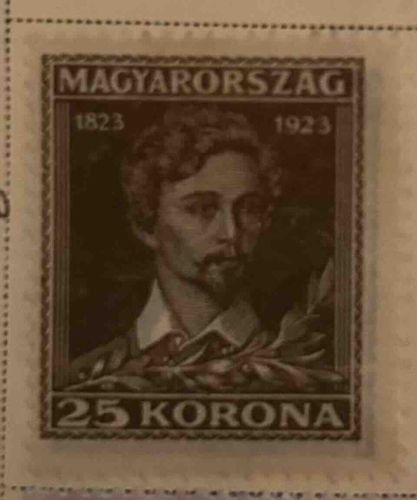
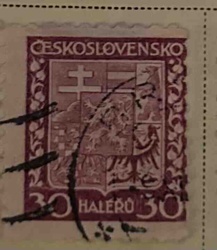
This item is a Hungarian commemorative postage stamp, likely issued in 1923, depicting a male bust within a rectangular frame. The stamp features a sepia or monochromatic color scheme, giving it an aged appearance. The central image is a portrait of a man, likely a historical figure, facing slightly to the right with a serious or contemplative expression. He has curly hair, a mustache, and a short beard (goatee). He is wearing a collared shirt under what appears to be a jacket or cloak. Below the portrait, a leafy wreath or garland is visible, symbolizing honor or achievement. The top border of the stamp clearly reads 'MAGYARORSZAG' (Hungary), indicating its country of origin. Below this, separated by the portrait frame, are the dates '1823' on the left and '1923' on the right, suggesting a centenary commemoration. The bottom border of the stamp displays the denomination '25 KORONA', identifying its postal value. The stamp has perforated edges, a standard feature for most postage stamps, indicating it was intended to be separated from a sheet. The overall condition appears good, with no obvious tears or significant creases visible, although some slight discoloration consistent with age is present. The printing quality seems fine, with clear details in the portrait and text. The aesthetic suggests a classical or historical style, common for commemorative issues of that era. Its purpose was to commemorate a significant event or person from 1823, celebrating its 100th anniversary in 1923.
AI Appraisal Report
I have carefully examined the provided image of the Hungarian 25 Korona Commemorative Stamp (1823-1923). The stamp appears to be authentic, consistent with known issues of this period. Its visual characteristics, including the 'MAGYARORSZAG' inscription, the dates '1823' and '1923', the '25 KORONA' denomination, and the portrait of the historical figure (likely Sándor Petőfi, a prominent Hungarian poet), align with historical records for this issue. The sepia-toned monochromatic scheme and perforated edges are also typical. I assess the condition as fine to very fine, exhibiting slight discoloration consistent with age but no apparent tears, major creases, or thinning, from what can be discerned in the image. The printing details seem clear and well-preserved.
From a market perspective, this particular 25 Korona commemorative stamp is not considered rare. It was issued in relatively high quantities and is readily available on the philatelic market. While attractive, demand is generally moderate, driven by collectors focusing on Hungarian philately or centenary issues. Comparable sales of this stamp in similar condition typically range from $5 to $15. Factors impacting value are primarily condition (unmounted mint is most desirable), centering, and gum integrity.
It is important to note the limitations of this appraisal. Authenticity verification is based solely on the provided image. A full, in-person examination would be required to confirm authenticity with 100% certainty, allowing for inspection of paper type, watermarks (if applicable), printing methods, gum condition, and potential hidden flaws not visible in the photograph. Expert verification can also rule out common forgeries or alterations. Without physical inspection, provenance documentation, or scientific testing, aspects like gum quality or minor imperceptible repairs cannot be definitively assessed. However, based on the clear image, I have no immediate reason to doubt the stamp's authenticity or the general condition assessment.