AI estimate as of November 9, 2025 · verify with a professional before acting
AI-Generated · Verify before acting
Everything on this page is generated by AI for informational purposes only. AI can make mistakes — the AI may misidentify items or misattribute them (artist, maker, brand, designer, origin, era). This is not an official valuation and should not be used for insurance, sale, tax, estate, legal, or lending purposes — or any decision requiring a certified appraisal. It is not an authoritative claim about any person, brand, or rights holder — do not share or rely on it as a factual statement about a third party. Always consult qualified professionals before making financial decisions.
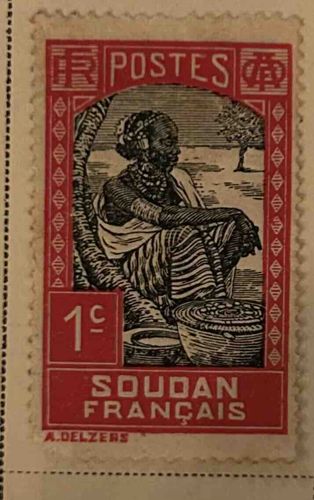
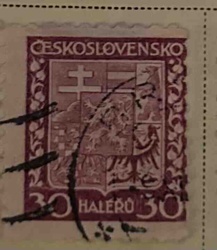
This is a vintage postage stamp from French Sudan, featuring a depiction of a seated African woman. The stamp primarily uses a striking red-brown color for its border and text elements, contrasting with the black ink used for the central vignette. The woman, possibly an indigenous inhabitant, is shown in traditional attire, with visible neck and wrist adornments (possibly beads or bangles). She appears to be engaged in a domestic activity, seated beside a large woven basket or bowl, and another smaller vessel. The background suggests an outdoor setting with a tree visible in the distance on the right. The top border of the stamp clearly displays 'POSTES' (French for 'Posts') flanked by decorative elements. The denomination '1f' (indicating 1 Franc) is prominently featured in the lower-left corner of the central image. Below the central image, the text 'SOUDAN FRANAIS' (French Sudan) is inscribed in capitalized letters. In the lower-left corner, beneath the denomination, the name 'A. DELZERS' is printed, likely referring to the engraver or designer. The stamp exhibits classic perforations around its edges, indicating it is an unused or uncancelled stamp, or at least a portion of one. The overall condition appears good with clear printing, though some minor discoloration or aging of the paper is possible given its age. The style suggests an early to mid-20th-century colonial issue, characterized by detailed engraving and a focus on ethnographic subjects.
AI Appraisal Report
Based on my visual examination of the provided image of this French Sudan 1 Franc postage stamp, I assess it to be an authentic issue from the colonial era. The design, including the depiction of the African woman, the 'POSTES' and 'SOUDAN FRANÇAIS' inscriptions, the '1f' denomination, and the visible engraver's name 'A. DELZERS', are all consistent with known examples of this stamp (Scott #36 or similar, depending on precise cataloging variations). The dual color (red-brown and black) printing is also characteristic of definitive stamps from this period.
From the image, the stamp appears to be in good, likely unused condition, suggested by the intact perforations and the absence of any visible cancellation marks. The printing is clear and well-centered. While I note the mention of potential minor discoloration or aging, which is common for stamps of this age, I cannot definitively assess this from a photograph alone. Mint, unused examples of this stamp tend to command higher values.
Market conditions for French colonial stamps vary. While not exceptionally rare, good condition, unused examples of definitive issues like this maintain steady collector interest. Factors impacting value include the precise shade (which can sometimes differentiate varieties), gum condition (if unused), and centring. Without seeing the reverse or the gum, or measuring the precise perforations, a final determination of 'mint' condition is not possible.
Limitations to verification from images alone are significant. I cannot verify the gum condition, presence of hidden flaws like thins or creases that might be obscured by the image resolution or angle, or if it is a re-gummed example. Full authentication and a precise grading would require in-hand examination, including inspection under magnification, assessment of gum (if applicable), perforation measurement, and potentially comparison with known genuine examples through philatelic expertise. Provenance documentation, though less common for individual stamps, would also add to certainty. My estimated value assumes a genuinely unused stamp in fine-to-very fine condition.