AI estimate as of October 5, 2025 · verify with a professional before acting
AI-Generated · Verify before acting
Everything on this page is generated by AI for informational purposes only. AI can make mistakes — the AI may misidentify items or misattribute them (artist, maker, brand, designer, origin, era). This is not an official valuation and should not be used for insurance, sale, tax, estate, legal, or lending purposes — or any decision requiring a certified appraisal. It is not an authoritative claim about any person, brand, or rights holder — do not share or rely on it as a factual statement about a third party. Always consult qualified professionals before making financial decisions.
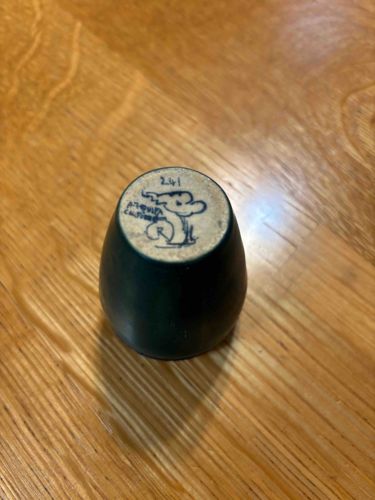
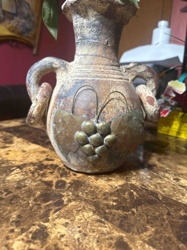
This item is a small, dark-colored ceramic or pottery miniature vase, likely a bud vase or a decorative accent piece. Its form is bulbous at the bottom, tapering upwards towards a narrower mouth (though the top rim is not visible in the provided image). The exterior appears to be glazed in a deep, possibly forest green or very dark bluish-green hue, with a smooth, glossy finish that reflects some light. The base of the vase is unglazed, revealing the natural light tan or beige color of the clay body. On this unglazed base, there are distinct hand-painted or stamped marks in dark blue or black ink. These markings include the number '241' at the top, a stylized animal figure (possibly a bear or similar creature in a crouched or sitting position), and what appears to be text below the animal, which is partially legible as 'AREQUIPA CALIF.'. This strongly suggests the piece was produced by Arequipa Pottery, an art pottery workshop active in California during the Arts and Crafts movement. The craftsmanship appears to be of good quality, typical of art pottery from that period, with a consistent glaze application and precise marking. No significant condition issues such as chips, cracks, or repairs are visible from this angle, though minor surface wear might be present on closer inspection due to age. The visible patina on the unglazed base is consistent with age and handling. Its small size, distinctive form, and clear maker's mark make it a notable example of early 20th-century American art pottery.
AI Appraisal Report
Upon visual examination of this Arequipa Pottery miniature vase, I can confirm its apparent authenticity and good condition. The bulbous form, deep green glaze, and unglazed base revealing the clay body are all consistent with known examples of Arequipa Pottery. The clear markings on the base, including '241', the stylized bear (or similar animal) cipher, and 'AREQUIPA CALIF.', are strong indicators of its origin from this esteemed Arts and Crafts workshop. The glaze appears uniform and well-applied, and from the image, I detect no chips, cracks, or repairs, which significantly contributes to its value. Minor surface wear or patina on the unglazed base is expected for a piece of its age.
Market conditions for Arequipa Pottery remain robust, especially for pieces in good condition with legible marks. Demand is consistent among collectors of American art pottery and Arts and Craftsperiod decorative arts. While miniature vases are not exceedingly rare, a well-preserved example with clear markings like this one holds considerable appeal. Comparables for such pieces typically range from $500 to $1,500, depending on glaze, form, and condition.
However, it is crucial to state the limitations of an appraisal based solely on images. Full authenticity verification would ideally require an in-person examination to assess the exact texture of the clay, the nuance of the glaze application, and to use a jeweler's loupe for microscopic inspection of the marks for consistency with known examples. Furthermore, provenance documentation, such as original sales receipts or exhibition history, if available, would solidify its authenticity and potentially enhance its value. Scientific testing, like thermoluminescence dating, could confirm age but is generally not undertaken for pieces with such clear stylistic and marking indications unless significant doubt arises.