These notes were written by the person who submitted this item. Appraiser.AI has not verified them, and the AI's identification and estimate may rely on them.
AI Estimated Value
Not an official valuation
$40-$75
AI estimate as of October 12, 2025 · verify with a professional before acting
AI-Generated · Verify before acting
Everything on this page is generated by AI for informational purposes only. AI can make mistakes — the AI may misidentify items or misattribute them (artist, maker, brand, designer, origin, era). This is not an official valuation and should not be used for insurance, sale, tax, estate, legal, or lending purposes — or any decision requiring a certified appraisal. It is not an authoritative claim about any person, brand, or rights holder — do not share or rely on it as a factual statement about a third party. Always consult qualified professionals before making financial decisions.
This analysis also relies on unverified notes provided by the user, which may be incomplete or inaccurate and could affect the result.
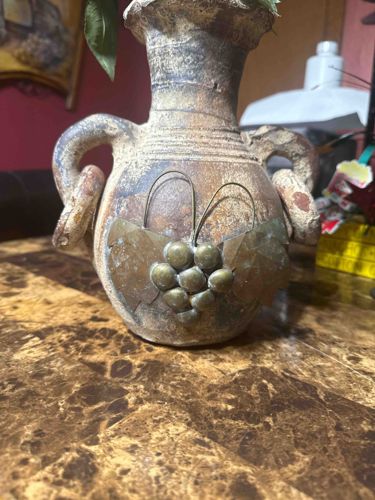
This appears to be a decorative clay pot, possibly referred to as an amphora-style vase due to its two handles, though it is not a true amphora in form. It is constructed from a coarse reddish-brown clay, which has been given a distressed or antiqued finish, characterized by lighter beige and grey wash-like applications that highlight the texture and grooves. The surface of the pot is unglazed and exhibits a rustic, earthy aesthetic, showing some wear and possibly artificial aging techniques, such as minor chips or rough patches that contribute to its vintage appearance. The main body tapers towards a narrow neck, which flares out slightly at the rim. Horizontal bands or ridges are clearly visible around the neck and shoulder of the pot, indicating a hand-thrown or molded process, or at least a design mimicking such a technique. Adorning the front of the pot is a prominent decorative motif: a cluster of grapes fashioned from small, round, metallic beads (likely brass or copper-toned metal), surrounded by several leaf-like elements made from a similar sheet metal. These metallic elements display a darkened patina, suggesting age or an intentional aged finish. Two sturdy, C-shaped handles emerge from the shoulder of the pot and loop back to its upper body, adding to its classic, historical-inspired design. The overall impression is one of a rustic, decorative vessel, likely intended for display rather than functional use with liquids. Its style suggests a Mediterranean or Renaissance revival influence, possibly dating from the mid-20th century to contemporary times, designed to evoke an ancient artifact. No discernible maker's marks or signatures are visible in the provided images. The quality of craftsmanship is utilitarian for a decorative piece, focusing on aesthetic appeal over fine finishing, as evidenced by the somewhat uneven surfaces and rustic construction.
AI Appraisal Report
Upon visual examination of this handled clay pot, I assess it to be a decorative piece of modern, likely late 20th-century, manufacture. The style references classical forms like the amphora but is not a true antique. The distressed, rustic finish and applied metallic grape motif are characteristic of mass-produced decorative home goods intended to evoke a Mediterranean or Tuscan aesthetic. The condition appears to be good for its intended decorative purpose, with the wear, patina, and minor chips likely being part of the original 'antiqued' design rather than subsequent damage.
The value of such an item is primarily determined by its decorative appeal rather than its age, maker, or rarity. It falls into the category of mass-market, factory-produced decorative art. Based on sales of comparable rustic-style ceramic and earthenware vessels on platforms like eBay, Etsy, and at second-hand home decor stores, the market is well-supplied with similar items. Demand exists, but the lack of a known maker or unique artistic merit limits its value to a decorative, rather than a collector's, price point.
Without a physical inspection, it is impossible to definitively confirm the materials used (e.g., clay type, metal composition) or to locate any hidden maker's marks. However, the overall appearance strongly suggests it is not an ancient artifact or a piece of significant historical value. Full authentication and a more precise dating would require a physical examination to check for stamps or signatures, and provenance documentation would be necessary to establish any notable history, but neither is expected for an item of this type.