These notes were written by the person who submitted this item. Appraiser.AI has not verified them, and the AI's identification and estimate may rely on them.
AI Estimated Value
Not an official valuation
$125 - $225
AI estimate as of October 11, 2025 · verify with a professional before acting
AI-Generated · Verify before acting
Everything on this page is generated by AI for informational purposes only. AI can make mistakes — the AI may misidentify items or misattribute them (artist, maker, brand, designer, origin, era). This is not an official valuation and should not be used for insurance, sale, tax, estate, legal, or lending purposes — or any decision requiring a certified appraisal. It is not an authoritative claim about any person, brand, or rights holder — do not share or rely on it as a factual statement about a third party. Always consult qualified professionals before making financial decisions.
This analysis also relies on unverified notes provided by the user, which may be incomplete or inaccurate and could affect the result.
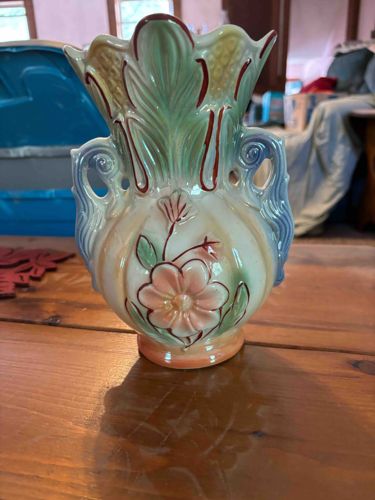
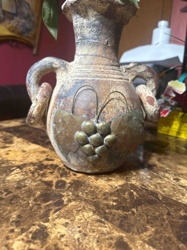
This item is a decorative art pottery vase, likely of Brazilian origin as indicated by the 'Brazil' marking described. It features a bulbous, ovoid body that tapers upwards into a fluted, undulating rim, giving it a somewhat organic, botanical appearance. The primary material appears to be glazed ceramic or earthenware, exhibiting a glossy finish. The color palette is pastel and multi-hued, featuring a creamy ivory or light beige base color that subtly transitions to pale blues on the side handles/forms and light greens and yellow-browns towards the rim. The decoration is relief-molded, with prominent stylized leaves forming the upper part of the vase's neck, particularly visible in hues of green and outlined with a reddish-brown trim. Two ornamental, scroll-like 'handles' or ear-like protrusions on either side of the vase are molded in pale blue with a fluted texture. The main body of the vase is adorned with hand-painted floral motifs; a notable pink flower with a yellow center is depicted, along with smaller reddish-pink stylized flowers and green foliage. These floral designs are outlined in a dark, possibly reddish-brown color, which also accents the rim and the molded leaf details. The base of the vase appears to be a separate, but integrated, foot element in a complementary orange-brown color, also with a glossy glaze. The overall condition is described as 'Excellent,' suggesting minimal to no visible wear, chips, cracks, or repairs. The craftsmanship indicates a factory production rather than a unique studio piece, but with careful hand-finishing in its painting and glazing. The style suggests it could be from the mid-20th century, possibly from the 1940s to 1960s, reflecting a decorative art pottery aesthetic popular during that period. The 'Brazil' marking would serve as a key identifier for its country of manufacture, influencing its categorization and potential provenance.
AI Appraisal Report
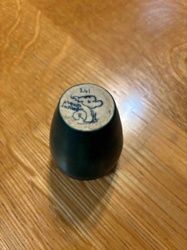
Based on my visual examination of the provided image and the owner's description, this decorative art pottery vase is in 'Excellent' condition, showing no apparent chips, cracks, or repairs. The 'Brazil' marking on the bottom is crucial for authenticating its origin. The overall craftsmanship, characterized by relief-molded and hand-painted details, coupled with a glossy glaze and pastel palette, is consistent with factory-produced decorative art pottery from the mid-20th century, likely 1940s-1960s.
Market conditions for vintage art pottery of this type from Brazil are moderate. While there is a niche market for such decorative pieces, they generally do not command premium prices unless they are from highly sought-after studios or designers, which is not indicated here. Comparables include similar decorative pottery vases from the mid-century period, often found in online marketplaces and antique shops. Demand is somewhat limited, driven by collectors of specific regional pottery or those seeking vintage decor. Its decorative appeal, excellent condition, and clear country of origin are positive value factors. The hand-painted floral motifs and relief-molded elements add to its aesthetic appeal.
My assessment of authenticity is based solely on the visual information and the reported marking. To verify authenticity definitively, a physical inspection would be essential to confirm the 'Brazil' mark's authenticity, examine the pottery more closely for manufacturing techniques, and assess the glaze and paint application for consistency with known Brazilian pottery of the era. Provenance documentation, though unlikely for such an item, would also strengthen its history. Without physical examination, I cannot definitively rule out reproductions or variations in quality that wouldn't be evident from images alone.