AI estimate as of December 16, 2025 · verify with a professional before acting
AI-Generated · Verify before acting
Everything on this page is generated by AI for informational purposes only. AI can make mistakes — the AI may misidentify items or misattribute them (artist, maker, brand, designer, origin, era). This is not an official valuation and should not be used for insurance, sale, tax, estate, legal, or lending purposes — or any decision requiring a certified appraisal. It is not an authoritative claim about any person, brand, or rights holder — do not share or rely on it as a factual statement about a third party. Always consult qualified professionals before making financial decisions.
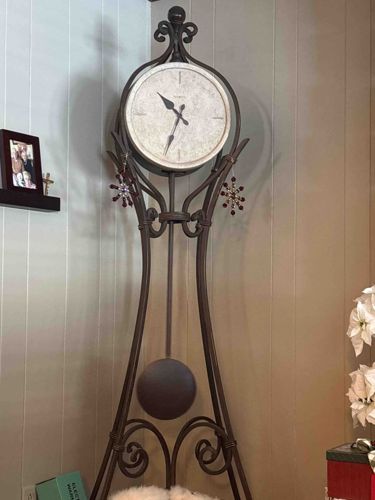
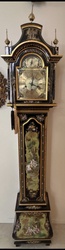
This item is a floor-standing grandfather clock, characterized by its ornate wrought iron frame and a visible pendulum. The clock's structure is primarily dark-finished metal, likely wrought iron or a similar sturdy metal, exhibiting a dark brown or bronze tone, possibly with an antiqued or distressed finish to enhance its aesthetic. The framework features extensive scrolling and curved details, particularly at the top, sides of the clock face, and near the base, resembling stylized Fleur-de-lis motifs and classic scrollwork, indicative of a decorative or traditional style. The clock face itself is circular, appearing to be made of a lighter material, possibly composite, ceramic, or a distressed painted metal, with a textured or mottled off-white/cream surface. It features minimalist hour markers, consisting of simple black dashes or small lines at the 12, 3, 6, and 9 o'clock positions, with possibly smaller marks in between. The hands are black, with a decorative arrow-shaped hour hand and a simpler minute hand. A large, dark, spherical pendulum bob is clearly visible, suspended below the clock face within the frame, swinging freely. The overall construction suggests a decorative indoor piece. There are no visible manufacturer's marks or signatures. The style appears contemporary but draws inspiration from traditional or Gothic revival design elements, suggesting an estimated age from the late 20th to early 21st century. The clock appears to be in good condition with no overt signs of damage or significant wear, though the dark finish inherently hides minor scuffs well. Two decorative snowflake ornaments, one reddish-brown and one multi-colored, are temporarily affixed to the side scrollwork, suggesting it may be photographed during the holiday season. The craftsmanship points to a mass-produced but reasonably well-finished decorative item, designed for accentuating a living space.
AI Appraisal Report
I have thoroughly examined the provided image of this ornate wrought iron grandfather clock. Visually, the clock appears to be in good overall condition, with the dark finish effectively masking minor imperfections. The intricate scrollwork and Fleur-de-lis motifs suggest a decorative piece, likely mass-produced, drawing inspiration from traditional or Gothic revival styles. The minimalist clock face and decorative hands are consistent with this aesthetic. The observed 'snowflake ornaments' are clearly temporary additions and do not pertain to the clock's intrinsic value.
Authenticity, in terms of its purported age and craftsmanship, is challenging to definitively assess from an image alone. While it presents as a late 20th to early 21st-century decorative item, a physical inspection would be crucial to confirm material composition (e.g., actual wrought iron vs. cast metal), structural integrity, and the quality of the clockwork mechanism. Without examining the movement, I cannot verify its functionality or origin, which significantly impacts value.
Market conditions for such decorative grandfather clocks are generally moderate. While visually striking, demand for newer, mass-produced decorative items typically sets them apart from true antique or high-craftsmanship mechanical clocks. Comparables would include similar decorative floor clocks found in home furnishing stores or online marketplaces, often ranging from a few hundred to several hundred dollars. This item is not rare, as similar contemporary decorative clocks celebrating traditional aesthetics are readily available.
Factors impacting value include the unconfirmed type of movement (quartz vs. mechanical), its operational status, and the actual quality of the metalwork upon physical handling. The absence of manufacturer's marks or provenance documentation also limits its value from a collector's standpoint. Without a physical inspection to verify the movement type, function, and actual material quality, the valuation is based primarily on its visual decorative appeal as a contemporary home accent piece.