AI Appraisal Estimate

AI-generated estimates · not official valuations

From the user

What was submitted

Photo and notes provided by the user — not generated by AI

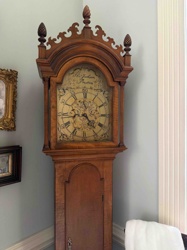
Submitted item photo
Submitted photo · June 12, 2026

User's notes

No additional notes provided.

AI analysis below

AI appraisal

AI analysis & estimate

AI-Generated · Verify before acting

Everything below is generated by AI for informational purposes only. AI can make mistakes — the AI may misidentify items or misattribute them (artist, maker, brand, designer, origin, era). This is not an official valuation and should not be used for insurance, sale, tax, estate, legal, or lending purposes — or any decision requiring a certified appraisal. It is not an authoritative claim about any person, brand, or rights holder — do not share or rely on it as a factual statement about a third party. Always consult qualified professionals before making financial decisions.

Read the full disclaimer

AI Identification

·Not independently authenticated·Verify before acting

Traditional Chippendale Style Grandfather Clock

Antique/Vintage Furniture & Horology

AI Estimated Value

·Not an official valuation·Verify before acting

$1,200 - $1,800

As of June 12, 2026

AI Item Analysis

·AI can make mistakes·Verify before acting
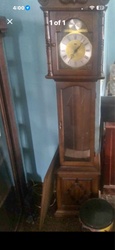
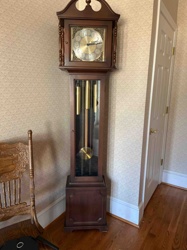
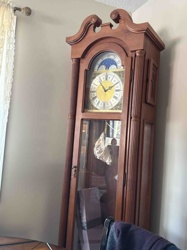
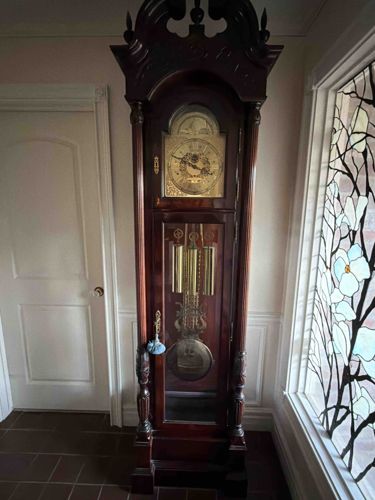
This is a freestanding longcase (grandfather) clock, likely dating from the mid-to-late 20th century. The piece features a dark cherry or mahogany finish on what appears to be a hardwood case. Its architectural design is characterized by a swan-neck or broken-pediment bonnet adorned with three flame-style finials and a central decorative carving. The clock face is housed behind a curved glass door and features an ornate golden-tone brass dial with scrolling filigree corner spandrels, a silver-tone chapter ring with Roman or Arabic numerals, and a secondary moon-phase dial located in the arch. The midsection contains a long, glass-paneled door revealing a polished brass lyre-style pendulum and three cylindrical weights, which indicate a cable-driven movement (likely 8-day). Flanking the trunk are reeded, inset columns that transition into decorative carvings toward the base. The base is structured with a stepped plinth and a cut-out apron. This clock is in good aesthetic condition, showing a deep luster and no apparent structural damage, though the presence of an aftermarket blue accessory tied to the handle suggests regular use. The overall craftsmanship suggests a high-quality reproduction by notable American makers such as Howard Miller or Ridgeway.
AI Appraisal Report

·AI can make mistakes·Verify before acting
Upon visual examination, I have assessed this Chippendale-style longcase clock as a high-quality mid-to-late 20th-century reproduction, likely manufactured by a firm such as Howard Miller or Sligh. The case displays excellent craftsmanship, featuring a mahogany-veneered hardwood frame with a classic swan-neck pediment and reeded pilasters. The movement appears to be a triple-chime, cable-driven mechanism with a moon-phase dial, which is highly desirable for collectors of traditional floor clocks. The cabinet exhibits a consistent luster and well-maintained finish, though the presence of an aftermarket accessory on the door handle indicates recent use and possible maintenance history. The current market for large-scale traditional horology has stabilized following a decline in the early 2010s; however, high-end American-made reproductions remain steady in the $1,200 to $1,800 range. Comparable sales for similar triple-weight models in good cosmetic condition typically fall within this bracket. Rarity is moderate, as these were produced in volume, but the quality of the casework adds a premium over base models. Significantly, several factors remain unverified through photography. A physical inspection is required to determine the maker's mark on the movement backplate and to check for gear wear or pivot fatigue. Specifically, I would need to inspect the movement to confirm the 'beat' and ensure the cable-winding drums are not frayed. Full authentication would require original purchase documentation or the manufacturer's model plate located inside the trunk. Without an in-person audit of the strike and chime sequence, the value assumes the movement is in full working order; a non-functional mechanism would reduce this valuation by approximately 50% due to the high cost of specialized horological repair.

Get your items appraised

Instant estimates of your treasures with AI-powered appraisals

Browse More Appraisals