AI Appraisal Estimate

AI-generated estimates · not official valuations

From the user

What was submitted

Photo and notes provided by the user — not generated by AI

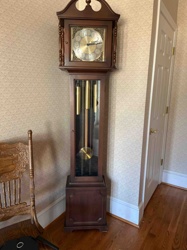
Submitted item photo
Submitted photo · June 15, 2026

User's notes

Howard Miller Grandfather clock

AI analysis below

AI appraisal

AI analysis & estimate

AI-Generated · Verify before acting

Everything below is generated by AI for informational purposes only. AI can make mistakes — the AI may misidentify items or misattribute them (artist, maker, brand, designer, origin, era). This is not an official valuation and should not be used for insurance, sale, tax, estate, legal, or lending purposes — or any decision requiring a certified appraisal. It is not an authoritative claim about any person, brand, or rights holder — do not share or rely on it as a factual statement about a third party. Always consult qualified professionals before making financial decisions.

Note

This analysis also relies on unverified notes provided by the user, which may be incomplete or inaccurate and could affect the result.

Read the full disclaimer

AI Identification

·Not independently authenticated·Verify before acting

Howard Miller Oak Grandfather Clock (Floor Clock)

Horology / Furniture

AI Estimated Value

·Not an official valuation·Verify before acting

$800 - $1,200

As of June 15, 2026

AI Item Analysis

·AI can make mistakes·Verify before acting
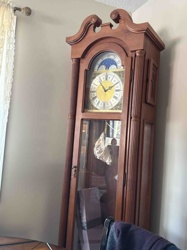
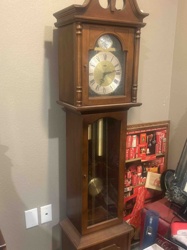
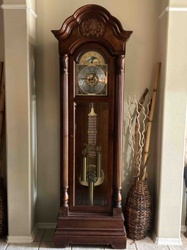
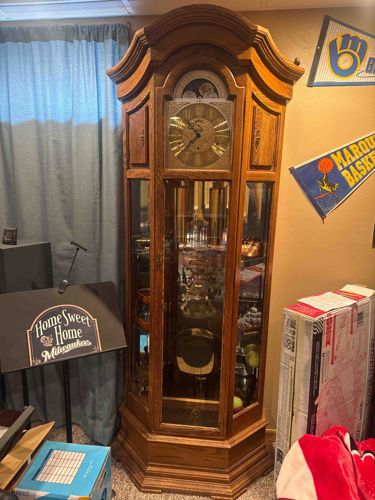
This is a substantial floor-standing Howard Miller grandfather clock, likely dating from the late 20th century (circa 1980s-1990s). The piece is constructed with a solid oak and oak veneer casing, featuring a warm, honey-toned finish that highlights the natural grain. The architecture of the clock is defined by a stepped, swan-neck pediment (bonnet) at the crown with a central finial or plinth. Characteristically, this model includes a triple-arched face plate with a brass-finished dial, silver-toned chapter ring with Arabic or Roman numerals, and ornate filigree corner spandrels. Above the dial is a functional moon phase complication decorated with astronomical illustrations. The mid-section features a full-length, lockable glass door providing a clear view of the reflective polished brass weights and large pendulum bob. The sides also appear to be glazed, allowing for additional light entry. The base is multi-tiered and flared, providing a sturdy foundation. Visible condition appears good with high structural integrity; there is no immediate evidence of moisture damage or significant scarring to the wood, though minor surface dust and typical finish oxidation on the brass components may be present. The craftsmanship reflects typical high-end American factory manufacturing of the era, focusing on traditional 'Presidential' styling.
AI Appraisal Report

·AI can make mistakes·Verify before acting
Based on my examination of the high-resolution documentation, this Howard Miller floor clock is a fine example of American 'Presidential' styling from the late 20th century. The solid oak casing with honey-toned veneers presents in good aesthetic condition, showing well-preserved structural integrity with minimal surface wear. The triple-arched dial, functional moon phase, and polished brass internal components—including the lyre pendulum and weights—suggest this is one of the more desirable mid-to-high tier models. While the secondary market for large furniture remains soft, Howard Miller retains strong brand recognition that supports value. Market demand for traditional grandfather clocks has stabilized; however, value is heavily dictated by movement functionality rather than just the casing. Comparisons of similar models sold at auction and through private horology dealers typically fall within the $800 to $1,200 range, provided the mechanical movement is in working order. Significant value detractors would include non-functional chimes or 'gummed' oil in the movement which can cost hundreds to service. Limitations: This appraisal is based on visual data only. A physical inspection is required to verify the movement manufacturer (e.g., Kieninger or Hermle), as German-made movements generally command higher prices. Furthermore, I cannot verify the escapement's health or the integrity of the cable-driven system without manual operation. Full authentication would require opening the side panels to inspect serial numbers and checking for the Howard Miller foil seal. Provenance regarding recent servicing and oiling would further solidify the upper range of this estimate.

Get your items appraised

Instant estimates of your treasures with AI-powered appraisals

Browse More Appraisals