AI Appraisal Estimate

AI-generated estimates · not official valuations

From the user

What was submitted

Photo and notes provided by the user — not generated by AI

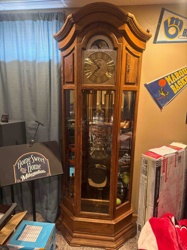
Submitted item photo
Submitted photo · June 28, 2026

User's notes

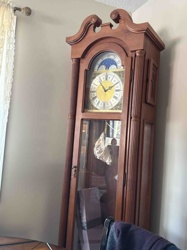
Grandfather clock since the early 70s. Labeled antique reproductions.

AI analysis below

AI appraisal

AI analysis & estimate

AI-Generated · Verify before acting

Everything below is generated by AI for informational purposes only. AI can make mistakes — the AI may misidentify items or misattribute them (artist, maker, brand, designer, origin, era). This is not an official valuation and should not be used for insurance, sale, tax, estate, legal, or lending purposes — or any decision requiring a certified appraisal. It is not an authoritative claim about any person, brand, or rights holder — do not share or rely on it as a factual statement about a third party. Always consult qualified professionals before making financial decisions.

Note

This analysis also relies on unverified notes provided by the user, which may be incomplete or inaccurate and could affect the result.

Read the full disclaimer

AI Identification

·Not independently authenticated·Verify before acting

Mid-20th Century Colonial Revival Grandfather Clock

Horology / Furniture

AI Estimated Value

·Not an official valuation·Verify before acting

$400 - $700

As of June 28, 2026

AI Item Analysis

·AI can make mistakes·Verify before acting
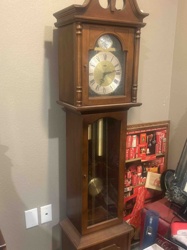
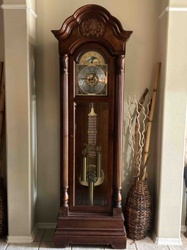
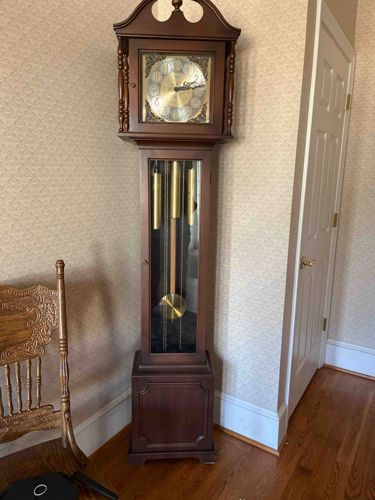
This is a freestanding grandfather clock, likely manufactured in the early 1970s as indicated by user context. The piece is a classic 'antique reproduction' designed in the Colonial Revival style. It features a solid wood and wood veneer case with a warm, reddish-brown mahogany or fruitwood finish. The top of the hood is characterized by a swan-neck pediment with a central turned finial, supported by fluted or turned columns flanking the dial door. The clock face displays a decorative brass dial with ornate spandrels in the corners and an inner silvered chapter ring with Roman numerals. Below the hood, the long waist section contains a rectangular glass door that reveals a set of three polished brass weights suspended by chains and a large brass pendulum disk. The base is simple with a recessed panel and sits flush on the floor with a subtle molding. Given its 1970s origin, the movement is likely an imported German mechanical works (such as Hermle or Urgos). The overall condition appears excellent for its age, showing a well-preserved original finish with minimal visible scuffing or light-induced fading. The brass components appear bright with only light surface oxidation, which is typical for vintage reproductions. The craftsmanship represents a mid-market production piece with mass-produced mechanical internal components and a factory-finished furniture cabinet.
AI Appraisal Report

·AI can make mistakes·Verify before acting
Based on my examination of this Colonial Revival grandfather clock, I have identified it as a high-quality reproduction piece from the early 1970s. The exterior cabinet, featuring a swan-neck pediment and mahogany-finished veneers, remains in excellent condition with minimal UV damage or finish checking. The brass dial and weight set show only minor patination, suggesting a well-maintained environment. While aesthetically pleasing, this clock was a mass-produced item during a period of high demand for 'antique-look' furniture. Market conditions for such clocks have shifted significantly; the current secondary market is saturated with similar 1970s-80s models, and buyer preference has moved toward smaller or more modern horology. Comparables at auction and estate sales typically range from $300 to $800 depending on the functionality of the movement. The value is primarily driven by its decorative utility as a furniture piece rather than horological rarity. Limitations: This appraisal is based on visual exterior evidence. I cannot verify the mechanical health of the German-made movement (e.g., Hermle or Urgos), the integrity of the suspension spring, or the presence of any internal wear without a physical inspection. A full authentication would require removing the hood to inspect the movement's serial numbers and brand stamp, as well as testing the strike and chime sequence. Provenance documentation or original purchase receipts would further confirm the exact manufacture date and original retail tier.

Get your items appraised

Instant estimates of your treasures with AI-powered appraisals

Browse More Appraisals