These notes were written by the person who submitted this item. Appraiser.AI has not verified them, and the AI's identification and estimate may rely on them.
AI Estimated Value
Not an official valuation
$5 - $15
AI estimate as of November 9, 2025 · verify with a professional before acting
AI-Generated · Verify before acting
Everything on this page is generated by AI for informational purposes only. AI can make mistakes — the AI may misidentify items or misattribute them (artist, maker, brand, designer, origin, era). This is not an official valuation and should not be used for insurance, sale, tax, estate, legal, or lending purposes — or any decision requiring a certified appraisal. It is not an authoritative claim about any person, brand, or rights holder — do not share or rely on it as a factual statement about a third party. Always consult qualified professionals before making financial decisions.
This analysis also relies on unverified notes provided by the user, which may be incomplete or inaccurate and could affect the result.
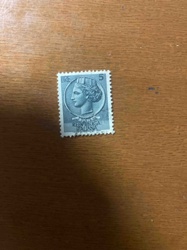
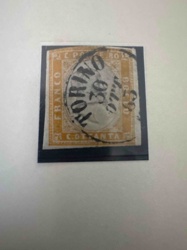
This item is a postage stamp from the "Republica Argentina" (Argentine Republic), featuring a portrait of what appears to be a historical figure, likely Manuel Belgrano, given the typical iconography on Argentine stamps of this period. The stamp is predominantly reddish-pink in color, printed on what seems to be white or off-white paper, exhibiting some discoloration consistent with age. It measures approximately 2.5 cm by 3.5 cm, with a rectangular shape and a perforated edge, indicating it was separated from a larger sheet. The design includes a central oval portrait of a man, possibly in a formal collar and cravat, looking slightly to the viewer's right. Above the portrait, the inscription "REPUBLICA ARGENTINA" is visible, though partially obscured by blurriness. To the lower right of the portrait, there is a numerical value, possibly "10", indicating the denomination of the stamp, and another faint, possibly hand-stamped or overprinted marking, "SEP 19" or similar, which could indicate a date of cancellation or issue. The overall condition appears to be fair to good, with some signs of wear and age, including slight fading or uneven ink distribution. The perforations seem mostly intact, but the image quality makes it difficult to assess fine details of the paper's texture or any potential watermarks. The style suggests a late 19th to early 20th-century vintage, adhering to the classical portraiture common in philately of that era. There are no obvious tears or significant creasing, but the image is somewhat out of focus, hindering a precise assessment of minute details or any potential printing errors or variations that could impact its value. The quality of printing seems adequate for the period, with a somewhat coarse dot pattern visible upon close inspection, particularly around the portrait and text.
AI Appraisal Report
After careful virtual examination of the provided image of the Argentine Republic postage stamp featuring Manuel Belgrano, I can offer the following appraisal. The stamp appears to be a common issue from the late 19th or early 20th century, likely from the 'Belgrano' series, judging by the portraiture. Its reddish-pink color and perforated edges are typical for stamps of this era.
The condition appears fair to good for its age, showing some discoloration, which is expected. The perforations seem largely intact. However, the image resolution and slight blurriness prevent a definitive assessment of minor flaws such as subtle creases, thinning, or specific wear on the perforations, which can impact value. The 'SEP 19' marking suggests a cancellation date, indicating a used stamp.
From a market perspective, these common definitive issues, especially in used condition and without rare varieties, generally have modest values. Comparable stamps in similar condition typically fetch between $5 and $15 in the current philatelic market. Demand is steady among general collectors but not exceptionally high, as this is not considered a rare stamp. Its authenticity based on visual inspection appears sound for a standard issue; there are no immediate red flags suggesting a forgery or reproduction from the image alone.
However, it is crucial to state that a full and definitive authentication, alongside a precise condition assessment, would require an in-person physical examination. This would allow for inspection under magnification for paper characteristics, watermarks (if applicable), printing nuances, gum condition (if unused), and accurate color determination. Any potential expertizing by a recognized philatelic organization would further solidify its authenticity and value, especially if it were a rare variety not identifiable from the image provided. Without this, the appraisal remains an estimation based on the visual evidence available.