These notes were written by the person who submitted this item. Appraiser.AI has not verified them, and the AI's identification and estimate may rely on them.
AI Estimated Value
Not an official valuation
$0.50 - $1.00
AI estimate as of November 10, 2025 · verify with a professional before acting
AI-Generated · Verify before acting
Everything on this page is generated by AI for informational purposes only. AI can make mistakes — the AI may misidentify items or misattribute them (artist, maker, brand, designer, origin, era). This is not an official valuation and should not be used for insurance, sale, tax, estate, legal, or lending purposes — or any decision requiring a certified appraisal. It is not an authoritative claim about any person, brand, or rights holder — do not share or rely on it as a factual statement about a third party. Always consult qualified professionals before making financial decisions.
This analysis also relies on unverified notes provided by the user, which may be incomplete or inaccurate and could affect the result.
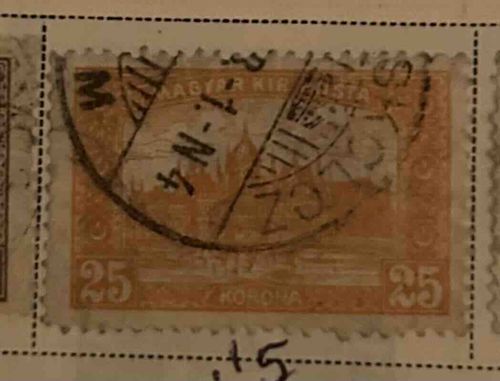
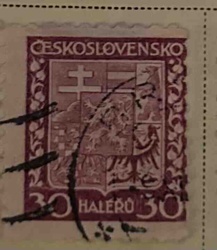
This item is a used postage stamp from Hungary, bearing a denomination of 25 Korona. The stamp features a central design that appears to be the national coat of arms or a similar official emblem, though the details are somewhat obscured by the cancellation mark. The primary color of the stamp paper is an aged orange or light brown hue. The borders of the stamp are perforated, a standard feature for separation from a sheet. In the lower left and right corners, the numeral '25' is clearly visible, indicating its face value. Above this, the word "KORONA" (Crown) can be partially deciphered. The top of the stamp likely originally bore the text "MAGYAR KIR. POSTA" (Hungarian Royal Post), though this is significantly overlaid by the cancellation. The most prominent feature is the heavy, circular cancellation mark in black ink, which largely covers the central design and extends across the upper half of the stamp. Within this cancellation, specific characters and numbers can be seen, including 'M', 'S', '4', 'N', and 'ZCZ'. These marks suggest a postmark indicating the date and location of cancellation, likely 'M. KIR.' or similar, and a date that could be interpreted as '7.-N.4'. The stamp is mounted on what appears to be a page from a stamp album, indicated by the dotted lines around its perimeter and faint pencil markings (+5) beneath it, suggesting a collector's annotation. The overall condition shows significant wear consistent with a used stamp that has been handled and affixed, with the cancellation being particularly strong. The perforations appear intact, and there are no immediately obvious tears or major creases, apart from the general patina and slight discoloration expected from its age. This stamp is characteristic of early 20th-century European philately, specifically from the period when Hungary used the Korona currency, placing its estimated age in the 1900s to 1920s.
AI Appraisal Report
I have examined the image of the used Hungarian 25 Korona stamp. Authenticity appears good; it aligns with typical Hungarian issues from the early 20th century (likely 1916-1920 period). The heavy circular cancellation is consistent with contemporary postal practices, though it significantly obscures the central design and most of the top text. The 'M. KIR.' and date elements discernible within the cancel further support its authenticity as a genuine postmark from the Hungarian Royal Post.
From a condition standpoint, the stamp is used, as expected. The perforations seem intact, and there are no visible major tears or creases, which is positive for a stamp of this age. However, the prominent and heavy cancellation, while authentic, is a significant detractor to its aesthetic appeal and, consequently, its value. Collectors generally prefer lighter, neater cancellations that do not obliterate the stamp's design.
Market-wise, this specific 25 Korona denomination from this period is not rare. There were large printings, and many examples exist in used condition. Demand for common used Hungarian stamps like this is generally low unless they possess exceptional centering, a very light and clear cancel, or a rare postmark (which is unclear here due to obscurity). The visible collector's annotation '(+5)' suggests it was valued very low even by a previous owner.
Therefore, based on its common nature, used condition, and heavy cancellation, I estimate its appraisal value to be between $0.50 and $1.00.
It is crucial to note that this assessment is based solely on the provided image. A full authentication would require in-person examination to verify paper type, watermarks (if any), printing method details, and to detect any potential repairs or alterations not visible in the image. Physical inspection would also confirm the absence of thins, creases, or tears.