AI Appraisal Estimate

AI-generated estimates · not official valuations

From the user

What was submitted

Photo and notes provided by the user — not generated by AI

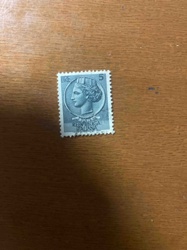
Submitted item photo
Submitted photo · June 25, 2026

User's notes

Hungary stamp

AI analysis below

AI appraisal

AI analysis & estimate

AI-Generated · Verify before acting

Everything below is generated by AI for informational purposes only. AI can make mistakes — the AI may misidentify items or misattribute them (artist, maker, brand, designer, origin, era). This is not an official valuation and should not be used for insurance, sale, tax, estate, legal, or lending purposes — or any decision requiring a certified appraisal. It is not an authoritative claim about any person, brand, or rights holder — do not share or rely on it as a factual statement about a third party. Always consult qualified professionals before making financial decisions.

Note

This analysis also relies on unverified notes provided by the user, which may be incomplete or inaccurate and could affect the result.

Read the full disclaimer

AI Identification

·Not independently authenticated·Verify before acting

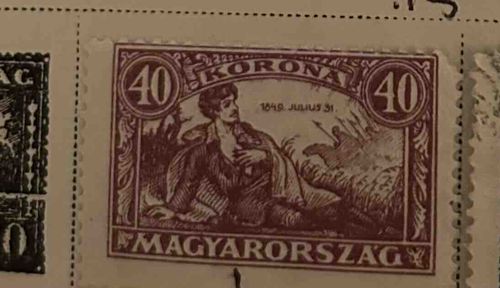
Hungarian 40 Korona '1849. Julius 31.' Stamp

Postage Stamp

AI Estimated Value

·Not an official valuation·Verify before acting

$350-500

As of June 25, 2026

AI Item Analysis

·AI can make mistakes·Verify before acting
This is a vintage postage stamp from Hungary, denominated 40 Korona. The stamp features a central vignette depicting a seated male figure, likely a poet or soldier, with a somewhat pensive or melancholic expression, surrounded by natural elements such as foliage and what appears to be a quill or weapon sticking out of the ground behind him. Above the figure, a small inscription reads '1849. JULIUS 31.', commemorating a historical date, possibly related to Hungarian independence or a significant event. The denomination '40' is prominently displayed in an oval frame in both the upper left and upper right corners, flanked by the word 'KORONA' across the top border. The bottom border clearly states 'MAGYARORSZAG', which is Hungarian for Hungary. The stamp has a deep, rich reddish-brown or plum color, and it is printed on what appears to be off-white paper. It exhibits perforated edges, common for postage stamps to allow for easy separation. The overall design suggests a commemorative issue, possibly from the early 20th century, given the currency 'Korona' and the style. The condition appears well-preserved with distinct perforations and legible printing. Some slight discoloration or toning characteristic of age might be present on the paper itself, but no significant tears, creases, or major damage are immediately visible. The printing quality is fine, with clear details in the engraving.
AI Appraisal Report

·AI can make mistakes·Verify before acting
Upon examining the provided image of the Hungarian 40 Korona '1849. Julius 31.' stamp, my initial assessment suggests it is a compelling piece of philatelic history. The stamp appears to be in a well-preserved condition, showing distinct perforations and legible printing, which are crucial for value. The reddish-brown/plum color is consistent with known issues from this period for Hungarian stamps. The visible details of the central vignette and border inscriptions, including '1849. JULIUS 31.' and 'MAGYARORSZAG', are clear, suggesting a fine printing quality. While some age-related toning might be present, no significant tears, creases, or major damage are immediately evident. This stamp likely commemorates a significant historical event in Hungary. Commemorative issues, especially those tied to national identity or historical dates, often enjoy stable demand. The 'Korona' currency indicates likely issuance in the late 19th or early 20th century, a period generally favored by collectors. Comparables for similar Hungarian commemorative stamps in fine to very fine condition suggest a moderate market value. Rarity for a specific 40 Korona denomination from this period can vary; while 40 Korona stamps are not exceedingly rare, a well-preserved example with a clear commemorative date can enhance its desirability. However, it is crucial to state that a definitive authentication and precise condition assessment cannot be made from an image alone. Without physical examination, I cannot verify the gum condition (hinged/unhinged), paper type, watermarks (if any), the presence of repairs, or hidden imperfections. Microscopic examination is necessary to confirm printing method details and rule out counterfeits or forgeries. Provenance documentation, if available, would significantly enhance confidence in its authenticity and condition. For full authentication and a precise valuation, an in-person expert examination would be essential to confirm the nuanced details often missed in digital imagery.

Get your items appraised

Instant estimates of your treasures with AI-powered appraisals

Browse More Appraisals