AI estimate as of November 9, 2025 · verify with a professional before acting
AI-Generated · Verify before acting
Everything on this page is generated by AI for informational purposes only. AI can make mistakes — the AI may misidentify items or misattribute them (artist, maker, brand, designer, origin, era). This is not an official valuation and should not be used for insurance, sale, tax, estate, legal, or lending purposes — or any decision requiring a certified appraisal. It is not an authoritative claim about any person, brand, or rights holder — do not share or rely on it as a factual statement about a third party. Always consult qualified professionals before making financial decisions.
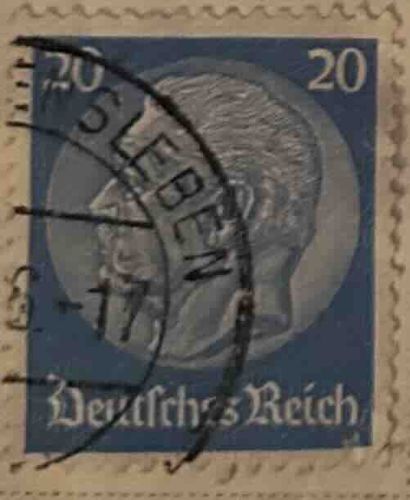
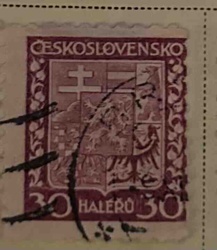
This item is a vintage postage stamp from the German Empire, issued during the Hindenburg period. The stamp is predominantly blue in color, featuring a profile portrait of Paul von Hindenburg, a prominent German statesman, within a circular frame. The denomination '20' is visible in the upper left and upper right corners of the stamp, indicating its value as 20 Pfennig. Below the portrait, the phrase 'Deutsches Reich' (German Empire) is printed in an Old German script font. The stamp has perforated edges, characteristic of most postage stamps, though the full extent of the perforations is not perfectly clear due to the cropping of the image. A significant postmark, partially obscuring the left side of Hindenburg's portrait and encompassing part of the denomination, is prominently visible. The postmark appears to be circular or semi-circular and contains text, with discernible letters 'LEBEN' and numbers '17', suggesting a date or location. The overall condition of the stamp appears to be moderately good, showing clear signs of usage due to the postmark. There's potential for minor wear to the edges or corners due to age and handling, consistent with a used postage stamp. The blue color exhibits a slightly muted tone, which could be attributed to natural aging of the ink or photographic lighting. The quality of printing seems fine, typical for government-issued postage at the time, indicating standard craftsmanship. The specific design featuring Hindenburg is well-known in philatelic circles, dating this stamp to likely the mid-1920s to early 1930s.
AI Appraisal Report
I have examined the provided image of the German Empire Hindenburg 20 Pfennig postage stamp. Based on my visual assessment, the stamp appears to be an authentic example from the Hindenburg series, common during the Weimar Republic era. The design, including the portrait of Hindenburg, the "20" denomination, and "Deutsches Reich" lettering, is consistent with known examples of this issue.
The condition of this specific stamp is used, denoted by the prominent circular postmark partially obscuring the portrait and denomination. While the postmark shows some cancellation details like "LEBEN" and "17," it significantly impacts the aesthetic appeal and, consequently, the value. The stamp exhibits typical wear for an item of its age that has been in circulation, with potential minor imperfections along the perforated edges, though these are not fully clear from the image. The blue color appears somewhat muted, which is often seen with age or can be influenced by lighting in the photograph.
From a market perspective, this particular Hindenburg issue (Scott #367 or similar, depending on perforation and watermarks) is very common. Millions were printed, leading to a consistently low market value for used examples. Demand for common, used stamps like this is generally modest among philatelists, primarily driven by new collectors or those seeking to fill basic album spaces. The heavy postmark further reduces its desirability compared to lightly canceled or unused examples.
Factors limiting value include its commonality, the heavy cancellation, and the general condition which, while not poor, is not exceptional. For full authentication and a more precise condition assessment, a physical examination would be necessary to check for hidden thins, repairs, precise perforation count, watermarks, gum condition (if unused, though this is clearly used), and paper quality. These elements are crucial for professional grading but cannot be determined from an image alone. Given its common nature and used condition, even a perfectly preserved example of this specific stamp would not command a high price.