These notes were written by the person who submitted this item. Appraiser.AI has not verified them, and the AI's identification and estimate may rely on them.
AI Estimated Value
Not an official valuation
$5 - $15
AI estimate as of November 10, 2025 · verify with a professional before acting
AI-Generated · Verify before acting
Everything on this page is generated by AI for informational purposes only. AI can make mistakes — the AI may misidentify items or misattribute them (artist, maker, brand, designer, origin, era). This is not an official valuation and should not be used for insurance, sale, tax, estate, legal, or lending purposes — or any decision requiring a certified appraisal. It is not an authoritative claim about any person, brand, or rights holder — do not share or rely on it as a factual statement about a third party. Always consult qualified professionals before making financial decisions.
This analysis also relies on unverified notes provided by the user, which may be incomplete or inaccurate and could affect the result.
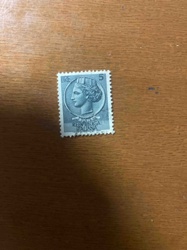
This item is a vintage postage stamp from India, denominated 'ONE ANNA'. The stamp features a dark, likely sepia or dark brown, ink printed on a light, cream-colored paper. The central motif is a detailed profile portrait of King George V, facing left, adorned with a royal crown and elaborate robes. This portrait is set within a circular frame, which is itself enclosed by a rectangular, ornate border. Above the portrait, the text 'INDIA POSTAGE' is clearly visible. Below the portrait, the denomination 'ONE ANNA' is displayed, with '1A' (representing '1 Anna') enclosed in a circular emblem between the words 'ONE' and 'ANNA'.
The stamp exhibits standard perforations along all four edges, indicating it was intended to be separated from a sheet. The visible condition suggests it is used, with a faint cancellation mark potentially present at the top, though not fully discernible. The color appears somewhat faded or aged, consistent with its probable vintage. The craftsmanship is typical of early 20th-century philately, showcasing fine line engraving for the portrait and decorative elements. The overall aesthetic points to an early to mid-20th-century period, likely during the British Raj era in India, given the depiction of a British monarch and the 'Anna' denomination, which was part of the Indian currency system during that time. The intricate detailing of the crown and robes, as well as the decorative border, suggests a high level of artistic and printing quality for its era. There are no obvious tears or major creases, but the exact condition of the perforations and the reverse side cannot be fully assessed from the provided image.
AI Appraisal Report
Based on my visual examination of the provided image, this appears to be a One Anna India Postage Stamp featuring King George V. The design, including the portrait, 'INDIA POSTAGE' inscription, and 'ONE ANNA' denomination, is consistent with known issues from the British Raj period. The printing in what appears to be sepia or dark brown on a light background is also typical for stamps of this era. I observe standard perforations on all four edges. The visible condition suggests it is a used stamp, with a faint cancellation mark potentially present. The color appears aged but not severely discolored. There are no obvious tears or major creases visible.
This particular stamp, the George V One Anna, is a common issue from India. Millions were printed and circulated. Therefore, while it is a genuine historical artifact, it is not considered rare. Demand for common used examples like this is generally low among serious collectors, though it may appeal to beginner collectors or those interested in British colonial philately. Market comparables for similar used examples in good condition typically range from a few dollars to perhaps fifteen dollars. Factors impacting its current value include its used status, the commonality of the issue, and the general condition, which appears to be fair to good, but not exceptional.
It is important to note the limitations of remote appraisal. While the visual details align with an authentic stamp, full authentication requires in-person examination. A physical inspection would allow me to accurately assess paper type, watermarks (if any), gum condition (if unused), the exact nature of the cancellation, and any subtle damage or repairs not visible in the image. Verifying the absence of hinge remnants on the reverse, and confirming the precise shade of ink are also crucial for definitive valuation which cannot be done from an image alone. Provenance documentation, though unlikely for such a common stamp, would also add to its history, but not significantly to its market value.