These notes were written by the person who submitted this item. Appraiser.AI has not verified them, and the AI's identification and estimate may rely on them.
AI Estimated Value
Not an official valuation
$100-180
AI estimate as of September 21, 2025 · verify with a professional before acting
AI-Generated · Verify before acting
Everything on this page is generated by AI for informational purposes only. AI can make mistakes — the AI may misidentify items or misattribute them (artist, maker, brand, designer, origin, era). This is not an official valuation and should not be used for insurance, sale, tax, estate, legal, or lending purposes — or any decision requiring a certified appraisal. It is not an authoritative claim about any person, brand, or rights holder — do not share or rely on it as a factual statement about a third party. Always consult qualified professionals before making financial decisions.
This analysis also relies on unverified notes provided by the user, which may be incomplete or inaccurate and could affect the result.
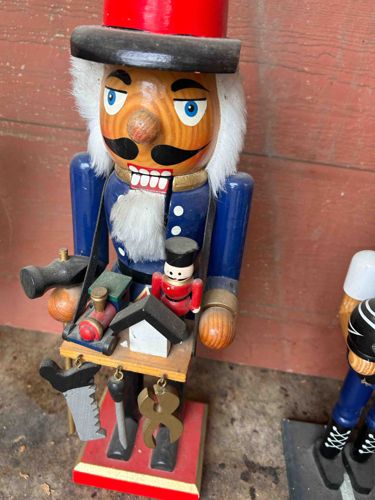
This is a hand-painted wooden nutcracker, likely of German folk art origin, styled as a figure with a distinct 'toy maker' or 'craftsman' theme. The figure stands on a rectangular wooden base painted red and white. Its face features carved details for the nose and chiseled eyes painted blue and black, with defined white teeth exposed in a 'cracking' mechanism. A prominent black handlebar mustache and black eyebrows are painted on, contrasting with the natural wood grain of the face. White faux fur or fiber material is used for the beard and hair, adding texture to the head. The figure wears a tall red top hat with a black brim and a dark blue jacket adorned with white dots for buttons, a light blue collar, and a white undershirt detail. It has light-colored wooden hands and lower legs, with black boots. A key distinguishing feature is the wooden tray or shelf attached to the front of the figure, displaying miniature wooden toys and tools. These include a small red and green toy train, a white house with a black roof, and a miniature red soldier figure. Hanging from the bottom of this tray are small wooden tools: a gray saw, a black screwdriver, and a golden '8' shaped wrench. The overall condition appears used with some signs of wear consistent with age, such as potential minor paint chipping or scuffs, though specific damage is not clearly visible at this resolution. The craftsmanship suggests a folk art style, often associated with Erzgebirge woodcraft, likely from the mid-to-late 20th century. The quality is indicative of traditional wooden toy manufacturing, with attention to detail in the painting and small accessory items.
AI Appraisal Report
Based on my examination of the provided image, this hand-painted wooden nutcracker, styled as a 'toy maker' with an integrated tray of miniature toys and tools, appears to be a charming example of German folk art, likely originating from the Erzgebirge region. The condition, from what can be discerned visually, seems good overall, consistent with a used decorative item of its age. I note the detailed carving for facial features, the application of faux fur for hair and beard, and the intricate painting of the attire and the miniature accessories. There are no immediately apparent significant damages like large chips, cracks, or extensive paint loss in the images provided, though minor scuffs or paint wear would be expected with age.
Authenticity, as a traditional German craft piece, appears reasonable given the style; however, without an in-person examination, I cannot definitively verify its origin or specific artisan. I would look for maker's marks or labels on the base during a physical inspection. Market conditions for decorative nutcrackers vary widely. While antique or highly collectible examples can fetch high prices, mass-produced or later 20th-century pieces, even those crafted in traditional styles, typically fall into the decorative collectible category. The unique 'toy maker' theme with its detailed tray adds a layer of interest, potentially appealing to collectors of both nutcrackers and miniature folk art. Demand for such items is generally steady among collectors, but this particular piece is not exceedingly rare. Factors impacting value include the quality of craftsmanship, condition, and the presence of any verifiable artisan marks.
My valuation of $100-180 reflects a well-preserved decorative nutcracker with a desirable theme and good detailing. A full authentication would require physical inspection to assess the type of wood, specific construction details, confirm the absence of modern mass-production indicators, and check for any artist signatures or region-specific markings. Provenance documentation, if available, would significantly aid in verification.