AI estimate as of September 16, 2025 · verify with a professional before acting
AI-Generated · Verify before acting
Everything on this page is generated by AI for informational purposes only. AI can make mistakes — the AI may misidentify items or misattribute them (artist, maker, brand, designer, origin, era). This is not an official valuation and should not be used for insurance, sale, tax, estate, legal, or lending purposes — or any decision requiring a certified appraisal. It is not an authoritative claim about any person, brand, or rights holder — do not share or rely on it as a factual statement about a third party. Always consult qualified professionals before making financial decisions.
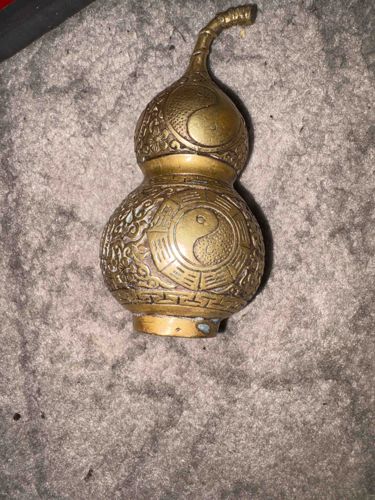
This item is a decorative brass gourd, commonly known as a 'Hulu' in East Asian cultures, particularly China. It is constructed from brass, exhibiting a rich, golden-brown metallic hue with an aged patina that suggests some antiquity or intentional antiquing. The gourd shape is distinctive, featuring a smaller upper bulb and a larger lower bulb, connected by a narrow waist. The surface of the gourd is extensively adorned with intricate relief carvings. On both the upper and lower bulbs, there are prominent circular motifs depicting the Taijitu symbol (Yin and Yang), surrounded by what appear to be the Eight Trigrams (Ba Gua), which are fundamental symbols in Taoist cosmology, often associated with Feng Shui and divination. Complementing these central symbols are curvilinear patterns and auspicious cloud or scroll motifs that fill the surrounding spaces, demonstrating fine craftsmanship and attention to detail. The top of the gourd features a curved stem-like protrusion, mimicking a natural gourd's vine and serving as a handle or finial. The overall condition appears good, with the aged patina contributing to its aesthetic, though some minor discoloration or residue (a bluish-white spot) is visible near the base, which may indicate surface oxidation or a past repair. No obvious chips, dents, or significant damage are discernible. The quality of the casting and the crispness of the carved details suggest a reasonably well-made item, likely intended for decorative or symbolic use. Given its style and common use as a symbol of good fortune, health, and longevity in Taoist traditions, it is most likely an item from the 20th century, possibly mid to late, though without distinct maker's marks or further context, a precise age is difficult to ascertain. It feels solid, implying a good weight for its size, contributing to its perceived quality.
AI Appraisal Report
Upon visual examination of the provided images, I have assessed this brass gourd, or 'Hulu'. The item appears to be a 20th-century decorative piece, cast in brass and featuring prominent Taoist symbolism, including the Taijitu and Ba Gua trigrams. The craftsmanship, with its detailed relief work, is of good quality for a decorative object. The aged patina seems consistent with its likely age, though it could be an intentional finish. A small bluish-white spot near the base is likely verdigris (copper/brass oxidation), which is common and does not significantly detract from the value in this context.
The market for such decorative Asian-inspired items is generally stable. Comparables would include similar cast brass Hulu gourds from the mid-to-late 20th century, which are relatively common and frequently appear at auction and online marketplaces. Demand is typically driven by decorative appeal and interest in Feng Shui or Taoist symbolism rather than significant antique value or rarity. This piece does not appear to be a rare antique; it is more likely a well-made collectible or decorative item. The primary factor limiting its value is its probable 20th-century origin and commonality.
It is crucial to note the limitations of an image-based appraisal. Without physical inspection, I cannot confirm the exact metal composition, a 'Made in...' mark underneath, the exact age, or distinguish between a natural patina and an applied finish. Full authentication would require in-person examination to check for maker's marks, tooling marks, and possibly metallurgical analysis to confirm the brass alloy and rule out modern reproduction techniques. Any provenance documentation would significantly impact this assessment.