AI estimate as of November 27, 2025 · verify with a professional before acting
AI-Generated · Verify before acting
Everything on this page is generated by AI for informational purposes only. AI can make mistakes — the AI may misidentify items or misattribute them (artist, maker, brand, designer, origin, era). This is not an official valuation and should not be used for insurance, sale, tax, estate, legal, or lending purposes — or any decision requiring a certified appraisal. It is not an authoritative claim about any person, brand, or rights holder — do not share or rely on it as a factual statement about a third party. Always consult qualified professionals before making financial decisions.
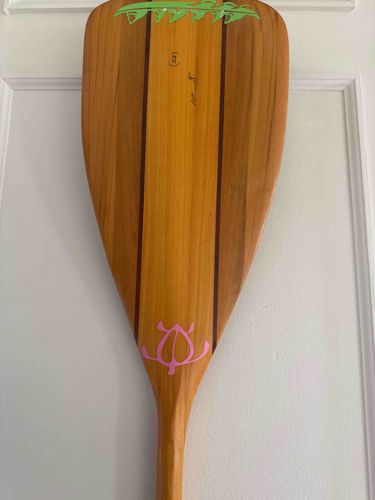
This is an artisan-crafted wooden paddle, likely intended for decorative purposes or light recreational use, rather than heavy-duty paddling. The paddle features a multi-wood construction, consisting of alternating strips of lighter and darker hardwoods, possibly cherry or maple for the lighter sections and walnut or a similar dark wood for the accent strips. The overall color palette is warm, ranging from a golden-brown to a rich, deeper brown, with a smooth, varnished or lacquered finish that highlights the natural wood grain. The blade of the paddle is broad and tear-drop shaped, transitioning smoothly into a narrower shaft, though the full length of the shaft and the handle are not visible in the image.
Distinguishing features include two hand-painted or stenciled decorative motifs. Near the tip of the blade, there is a lime-green, stylized design, which appears to represent a wave or a tribal pattern. Further down on the blade, closer to where it meets the shaft, there is a pink, stylized sea turtle or similar aquatic creature symbol. Above the pink turtle design, a faint circular mark with a 'J' or similar initial inside is visible, along with a handwritten signature that is difficult to decipher but suggests an artist's mark or maker's signature.
The condition appears to be excellent, with no visible signs of wear, damage, or repairs, suggesting it has been well-maintained or primarily used as a decorative piece. The craftsmanship indicates a good level of skill, with clean lines and smooth transitions between the wood strips. The combination of natural wood tones with vibrant, contrasting colors for the decorative elements gives it a unique and appealing aesthetic, hinting at a contemporary or modern folk art style. The paddle has a substantial, yet refined appearance, characteristic of a bespoke or limited-edition item.
AI Appraisal Report
Upon visual examination of the provided images, I have assessed this artisan wooden paddle. My appraisal is based on its craftsmanship, artistic merit, and current market conditions for contemporary decorative folk art.
The item is a skillfully constructed decorative paddle, featuring a laminated design of alternating light and dark hardwoods, likely maple or cherry paired with walnut. The craftsmanship is excellent, with smooth lamination lines and a high-quality gloss finish. Two stylized, painted motifs—a lime-green wave and a pink sea turtle—add unique artistic character. An artist's signature and a maker's mark are present, though illegible from the image, indicating it is a bespoke or studio piece rather than a mass-produced item. The condition appears excellent, free from any visible damage, wear, or repair.
The primary value driver is its quality as a decorative object. Demand for well-made, unique, contemporary folk art and decor items is solid. However, the value is significantly influenced by the identity and reputation of the maker. As the artist's signature is currently unverified, the paddle is valued as a high-quality studio craft piece. Comparables would be other signed, studio-made decorative paddles found in galleries, online artisan marketplaces, and art fairs, which typically range from $200 to $600 depending on the artist's renown.
A significant limitation of this appraisal is the inability to authenticate the signature or fully assess the materials and construction without physical inspection. For full authentication, I would need to examine the paddle in person to identify the specific woods, confirm the quality of the finish, and attempt to decipher and research the maker's signature. Documentation regarding the artist or provenance would substantially increase its value if the maker is established.