AI estimate as of November 8, 2025 · verify with a professional before acting
AI-Generated · Verify before acting
Everything on this page is generated by AI for informational purposes only. AI can make mistakes — the AI may misidentify items or misattribute them (artist, maker, brand, designer, origin, era). This is not an official valuation and should not be used for insurance, sale, tax, estate, legal, or lending purposes — or any decision requiring a certified appraisal. It is not an authoritative claim about any person, brand, or rights holder — do not share or rely on it as a factual statement about a third party. Always consult qualified professionals before making financial decisions.
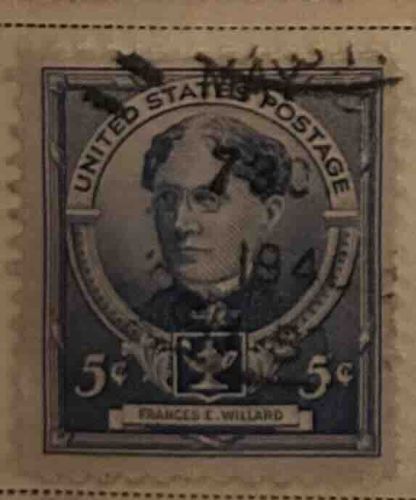
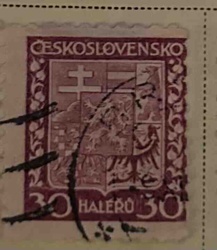
This is a 5-cent United States postage stamp featuring a portrait of Frances E. Willard, a prominent American suffragist, educator, and temperance reformer. The stamp has a predominantly blue-gray coloration with white text and accents. The central design is a circular portrait of Willard, depicted wearing glasses and looking slightly to the right. Her hair is styled up, and she appears to be dressed in formal attire indicative of the late 19th or early 20th century. Surrounding the portrait is an arched banner with the words "UNITED STATES POSTAGE" at the top. Below the portrait, the denomination "5$" is visible on both the left and right sides. A small decorative element resembling a chalice or urn is positioned centrally below the portrait. At the very bottom of the stamp, a rectangular panel contains the name "FRANCES E. WILLARD" in serif font. The stamp is bordered with a dark, possibly black or very dark blue, frame, detailed with some decorative motifs. It appears to be perforated along the edges, although the full extent of the perforations is not entirely visible. The condition shows some signs of wear, particularly at the top where some dark smudges or residues are present, possibly from handling or hinge marks. The paper itself appears to be a light tan or off-white. The overall aesthetic suggests a mid-20th-century design, likely from a commemorative or historical figure series. The crispness of the printing indicates good craftsmanship for its era.
AI Appraisal Report
I have examined the image of the 5-cent Frances E. Willard US Postage Stamp. This stamp is readily identifiable as Scott #786, issued in 1940 as part of the Famous Americans series. The design elements, including the portrait, text, and denominations, are consistent with authentic examples of this issue.
Regarding condition, based on the image, the stamp appears to be used, indicated by the visible smudges and residue at the top, likely from a hinge or cancellation mark not fully visible. The perforations seem intact, though their full extent and any potential faults cannot be definitively assessed. The paper exhibits some toning, which is common for stamps of this age. Overall, I would classify the condition as 'Fine-Very Fine Used,' assuming no major hidden faults.
Market conditions for this particular stamp are generally stable but low. It is not considered rare. The 5-cent Frances E. Willard stamp was issued in large quantities, making it widely available to collectors. Demand is primarily from general collectors of US postage, especially those completing the Famous Americans series. Comparables for used examples in similar condition typically range from $0.50 to $2.00.
Factors significantly impacting value for this specific stamp would include centering, completeness of perforations, absence of toning or creases, and a light, unobtrusive cancellation. Given the visible marks, this example would fall within the lower to mid-range of its market value.
It is important to note the limitations of image-based appraisal. While I can confirm the type and assess superficial condition, I cannot definitively verify authenticity without a physical examination. An in-person inspection would allow me to assess paper quality, gum condition (if unused), precise perforation measurements, and the nature of the visible residue. I would also look for watermarks or plate varieties, though those are less common for this specific issue. Provenance documentation could complement the physical inspection for higher-value items, but for this common stamp, it is not typically required.