AI Appraisal Estimate

AI-generated estimates · not official valuations

From the user

What was submitted

Photo and notes provided by the user — not generated by AI

Submitted item photo
Submitted photo · June 10, 2026

User's notes

No additional notes provided.

AI analysis below

AI appraisal

AI analysis & estimate

AI-Generated · Verify before acting

Everything below is generated by AI for informational purposes only. AI can make mistakes — the AI may misidentify items or misattribute them (artist, maker, brand, designer, origin, era). This is not an official valuation and should not be used for insurance, sale, tax, estate, legal, or lending purposes — or any decision requiring a certified appraisal. It is not an authoritative claim about any person, brand, or rights holder — do not share or rely on it as a factual statement about a third party. Always consult qualified professionals before making financial decisions.

Read the full disclaimer

AI Identification

·Not independently authenticated·Verify before acting

Carved Ebony Wood African Bust Figure

Collectibles - African Art & Sculpture

AI Estimated Value

·Not an official valuation·Verify before acting

$45.00 - $75.00

As of June 10, 2026

AI Item Analysis

·AI can make mistakes·Verify before acting
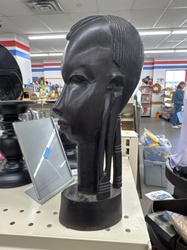
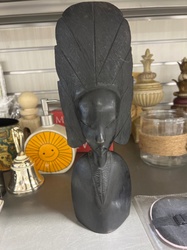
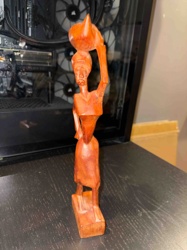
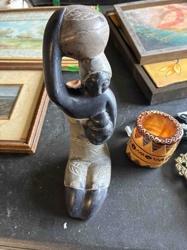
This is a hand-carved bust featuring a stylized African woman, likely an example of 20th-century Makonde artistry from East Africa or tourist-trade sculpture from West Africa. The piece is crafted from a single block of dense, dark wood, specifically ebony (Dalbergia melanoxylon), which is evidenced by the deep blackish-brown heartwood and the visible grain where the finish has slightly thinned. The figure stands approximately 7 to 8 inches tall, mounted on an integrated square plinth base. Notable physical features include an elongated cranium and neck, characteristic of traditional regional aesthetics, with a multi-tiered or wrapped headdress carved into the upper portion. The face exhibits closed eyes, full lips, and realistic facial proportions. A distinguishing feature is the inclusion of small metallic hoop earrings and a metallic wire necklace or 'choker' wrapped around the throat, which adds multi-media texture. The surface shows a soft, aged patina with mild wear on the high points of the nose and brow. There are no visible maker's marks or signatures in the provided view, suggesting it may be a folk-art or artisan workshop piece rather than a gallery-signed contemporary work. The craftsmanship is of high quality, demonstrating skilled subtractive carving techniques with smooth finishing and attention to anatomical detail. It likely dates from the mid-to-late 20th century.
AI Appraisal Report

·AI can make mistakes·Verify before acting
I have examined the digital representation of the hand-carved ebony bust. The piece exhibits the physical characteristics of 20th-century East African carvings, likely of Makonde origin or crafted for the regional export market. The use of true ebony (Dalbergia melanoxylon) is evident in the dense grain and high-contrast heartwood. The carving displays skilled subtractive technique, particularly in the stylized headdress and elongated anatomical features. The addition of metallic wire jewelry is a common decorative motif for mid-to-late 20th-century artisan works intended for the souvenir or interior decor trade. Condition appears good, with a well-developed patina and minor surface wear consistent with age. The current market for mid-century African folk art is saturated with similar souvenir-grade carvings. While the craftsmanship is superior to modern mass-produced replicas, the lack of a signature or documented provenance to a known master carver limits its value into the decorative rather than fine-art category. Comparable sales for 7-8 inch ebony busts consistently fall within the $40 to $80 range. Critically, this appraisal is based on photographic evidence only. Visual inspection alone cannot definitively confirm the wood species or differentiate between hand-tooling and machine-assisted finishing in recessed areas. A physical examination is required to check for internal 'checking' (cracks), hidden repairs with wood filler, or evidence of polish staining used to mimic ebony’s dark hue. To move this into a higher valuation bracket, provenance documentation linking it to a specific mid-century collection or gallery would be necessary.

Get your items appraised

Instant estimates of your treasures with AI-powered appraisals

Browse More Appraisals