AI Appraisal Estimate

AI-generated estimates · not official valuations

From the user

What was submitted

Photo and notes provided by the user — not generated by AI

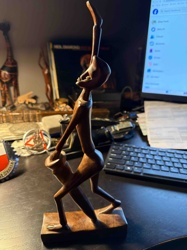
Submitted item photo
Submitted photo · June 12, 2026

User's notes

No additional notes provided.

AI analysis below

AI appraisal

AI analysis & estimate

AI-Generated · Verify before acting

Everything below is generated by AI for informational purposes only. AI can make mistakes — the AI may misidentify items or misattribute them (artist, maker, brand, designer, origin, era). This is not an official valuation and should not be used for insurance, sale, tax, estate, legal, or lending purposes — or any decision requiring a certified appraisal. It is not an authoritative claim about any person, brand, or rights holder — do not share or rely on it as a factual statement about a third party. Always consult qualified professionals before making financial decisions.

Read the full disclaimer

AI Identification

·Not independently authenticated·Verify before acting

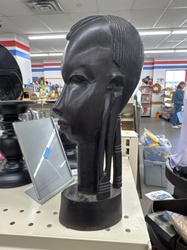
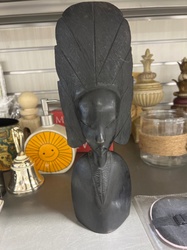
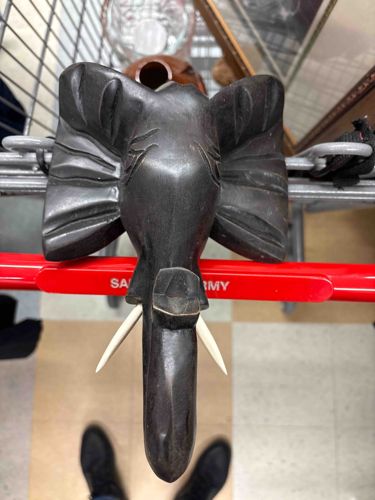
Hand-Carved Ebony Elephant Tusk Sculpture

Collectibles / African Art & Sculpture

AI Estimated Value

·Not an official valuation·Verify before acting

$45.00 - $75.00

As of June 12, 2026

AI Item Analysis

·AI can make mistakes·Verify before acting
This is a hand-carved sculpture depicting an African elephant head, likely crafted from genuine ebony wood or a similarly dense, dark hardwood finished with a black stain. The piece features large, flared ears with stylized concentric line carvings representing skin folds. The trunk is rendered in a downward, slightly curled position. Notably, the sculpture includes two lighter-colored inset tusks, possibly made of bone, plastic, or a lighter wood, which provide a sharp visual contrast against the dark body. The carving style is representative of mid-to-late 20th-century African folk art, often produced for the export and souvenir market. In terms of condition, there is visible surface wear, including white scuff marks on the top of the head and edges of the ears, and significant dust accumulation in the recessed carvings. The craftsmanship shows a blend of traditional motifs with a simplified, modern aesthetic. There are no visible maker's marks or signatures in the overhead view. The overall finish has a soft luster, suggesting it has been polished, though the patina indicates it has been handled frequently over several decades.
AI Appraisal Report

·AI can make mistakes·Verify before acting
I have examined the digital representation of this carved elephant bust. The piece exhibits the textural and stylistic hallmarks of mid-to-late 20th-century African 'airport art' or souvenir carvings, likely originating from East Africa (specifically Kenya or Tanzania). The material appears to be a dense tropical hardwood; while it may be Diospyros (Ebony), the surface wear suggests it could be a lighter wood treated with a dark ebony-style stain or shoe polish, which was common for export items of this era. The tusks are inset and appear to be carved bone or bovine horn rather than ivory, evidenced by the lack of Schreger lines and the specific grain pattern visible at the insertion points. Condition-wise, the piece shows significant 'shelf-wear' including scuffing to the forehead and ear ridges, which impacts the aesthetic value. The craftsmanship is competent but follows a mass-production aesthetic rather than a unique master-carver's signature style. In the current secondary market, such items are widely available on platforms like eBay and Etsy. Market demand for unsigned, mid-century souvenir carvings remains steady but modest, as they are viewed as decorative accessories rather than high-fine art investments. Important Limitations: This appraisal is based solely on visual inspection of images. A definitive valuation would require an in-person examination to confirm wood density through a weight test and to verify the tusk material via a hot-needle or microscopic test to rule out synthetic plastics or clarify the exact biological source of the bone. Provenance documentation regarding the date of import would also be necessary to ensure compliance with CITES regulations if the materials are later found to be protected species.

Get your items appraised

Instant estimates of your treasures with AI-powered appraisals

Browse More Appraisals