AI estimate as of November 10, 2025 · verify with a professional before acting
AI-Generated · Verify before acting
Everything on this page is generated by AI for informational purposes only. AI can make mistakes — the AI may misidentify items or misattribute them (artist, maker, brand, designer, origin, era). This is not an official valuation and should not be used for insurance, sale, tax, estate, legal, or lending purposes — or any decision requiring a certified appraisal. It is not an authoritative claim about any person, brand, or rights holder — do not share or rely on it as a factual statement about a third party. Always consult qualified professionals before making financial decisions.
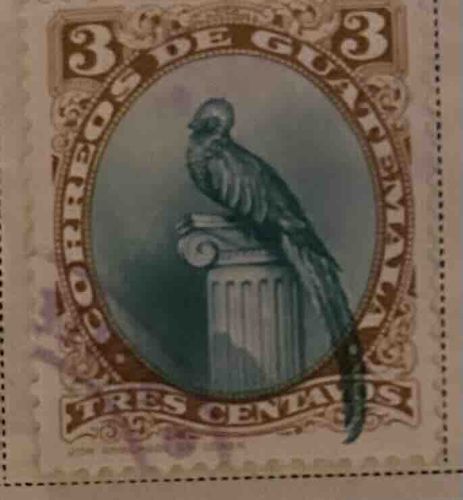
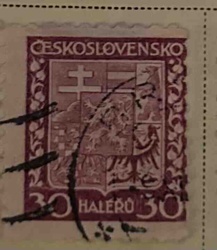
This item is a vintage postage stamp from Guatemala, with a denomination of '3 Centavos'. The stamp features a central oval vignette depicting a Resplendent Quetzal, the national bird of Guatemala, perched atop a classical column or pedestal. The quetzal is illustrated with its characteristic long tail feathers, rendered in shades of blue-green against a lighter, somewhat oxidized blue-green background. The oval vignette is framed by an ornate border in a reddish-brown or sepia tone, which also bears the inscription 'CORREOS DE GUATEMALA' at the top and 'TRES CENTAVOS' at the bottom. The number '3' appears in both upper corners within decorative shields. The overall color scheme combines the reddish-brown frame with the blue-green of the central image. The stamp exhibits a perforated edge, indicating it was part of a larger sheet. There are visible signs of wear, including a partial purple cancellation mark or postmark located near the bottom left corner of the central image frame, extending onto the 'O' of 'CORREOS' and the 'T' of 'TRES'. The paper itself appears to have some age-related discoloration or foxing, visible in the border areas. The printing shows fine detailing, particularly in the feathers of the quetzal and the decorative elements of the frame, suggesting a period of intricate engraving or lithography. The style suggests it likely dates from the late 19th or early 20th century. The quality of printing appears to be good for its presumed age, despite the visible cancellation and potential aging of the paper.
AI Appraisal Report
This Guatemala 3 Centavos Quetzal stamp, featuring the national bird, presents as a circulated example from likely the late 19th or early 20th century, given its design and apparent age. Based on visual examination, the stamp's condition is fair to good, with clear evidence of wear. I note a partial purple cancellation mark, which, while common for used stamps, impacts its pristine appearance. There's also some discoloration or foxing consistent with age, particularly in the border areas. The perforations appear intact, though minor imperfections are difficult to assess without physical inspection. The printing quality, despite wear, retains fine detail in the quetzal and decorative elements, suggesting good production originally.
From a market perspective, this type of stamp, while historically interesting, does not represent extreme rarity unless it’s an unlisted variety or in immaculate, unused condition without gum disturbance, which is not the case here. Demand for common used examples of this era from Guatemala is generally moderate among specialized collectors. Comparables suggest that used stamps of this denomination and condition typically fall into the modest double-digit range. The cancellation and age-related wear are significant factors limiting its value compared to an unused or lightly canceled specimen.
It's crucial to state that this appraisal is based solely on visual examination of the provided image. Full authentication requires an in-person examination to verify paper type, watermarks (if any), gum condition (if unused), and precise perforation measurements. Microscopic analysis could confirm printing technique and rule out modern forgeries. Provenance documentation would further boost confidence in its authenticity and history, though for stamps of this value, it's less common. Without physical inspection, I cannot definitively confirm its complete authenticity or rule out repairs not visible in the image.