AI estimate as of June 20, 2025 · verify with a professional before acting
AI-Generated · Verify before acting
Everything on this page is generated by AI for informational purposes only. AI can make mistakes — the AI may misidentify items or misattribute them (artist, maker, brand, designer, origin, era). This is not an official valuation and should not be used for insurance, sale, tax, estate, legal, or lending purposes — or any decision requiring a certified appraisal. It is not an authoritative claim about any person, brand, or rights holder — do not share or rely on it as a factual statement about a third party. Always consult qualified professionals before making financial decisions.
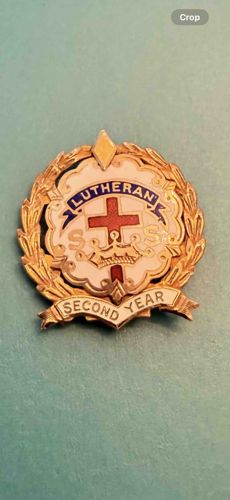
This is a gold-toned lapel pin or badge, likely made of brass or a similar base metal, featuring intricate enamel work. The pin has a central shield-like emblem with a white enamel background. "LUTHERAN" is arced across the top of this shield in blue enamel letters. Below "LUTHERAN" is a prominent red cross, a common symbol of Christianity. Flanking the cross are two stylized "S" letters in gold, possibly indicating a specific organization or society. Below the red cross and the 'S' letters, there's a gold crown design, adding to the regal or institutional aesthetic. The central shield is encircled by a detailed gold laurel wreath, signifying achievement or honor. At the very top of the pin, centered, is a small, raised diamond shape in gold. Below the main design, a banner scrolls across the bottom, also in white enamel with gold trim, bearing the inscription "SECOND YEAR" in raised gold letters. The overall construction appears solid and well-crafted, indicative of a commemorative or membership piece. There are no visible signs of significant damage such as chips in the enamel or bends in the metal, suggesting good preservation. The gold tone retains a subtle sheen, consistent with minimal wear or careful handling, though minor surface scratches typical of age might be present upon closer inspection. The style suggests it could date from the mid-20th century to a more contemporary period, likely a recognition or long-service award within a Lutheran organization or educational institution.
AI Appraisal Report
Upon visual examination of the provided image, I assess this Lutheran Second Year Recognition Pin to be in excellent condition. The enamel work appears intact without chips or cracks, and the gold-toned metal retains its luster with no apparent significant scratches, tarnishing, or bends. This suggests good preservation and careful handling over its lifespan. Authenticity, based solely on visual inspection, appears legitimate for a commemorative or membership pin of this type. The design elementsâ"LUTHERAN," red cross, "SECOND YEAR," laurel wreathâare consistent with fraternal or religious organizational recognition pieces. However, it's crucial to note that definitive authenticity verification from images alone is limited. I cannot ascertain the true material composition (e.g., gold plating vs. solid gold, specific base metal), the method of construction (e.g., stamped vs. cast), or the presence of any maker's marks or hallmarks without a physical in-hand examination. To fully verify authenticity, a direct physical inspection is essential to check for hallmarks, examine reverse-side details, and confirm material composition through non-destructive testing if necessary. Provenance documentation, such as original presentation boxes or accompanying certificates, would also significantly aid in authentication and potentially increase value.Market conditions for fraternal and religious pins of this nature are generally stable but niche. Comparables typically sell in the £15-£45 range, depending on rarity, organization, and specific design. While this pin is well-preserved and has a clear organizational affiliation, Second Year recognition pins are not inherently rare. Demand is primarily driven by collectors of religious memorabilia, specific organizational ephemera, or those seeking unique vintage items. Factors positively impacting value include its excellent condition and clear inscription. However, without a known prestigious origin, significant historical association, or precious metal content, its value remains primarily in its collectible rather than intrinsic material worth. Its collectibility is higher than a generic lapel pin due to its specific religious and recognition context, but not exceptionally so given its "Second Year" designation, which usually signifies an entry-level or early-stage recognition.