These notes were written by the person who submitted this item. Appraiser.AI has not verified them, and the AI's identification and estimate may rely on them.
AI Estimated Value
Not an official valuation
$60-120
AI estimate as of October 18, 2025 · verify with a professional before acting
AI-Generated · Verify before acting
Everything on this page is generated by AI for informational purposes only. AI can make mistakes — the AI may misidentify items or misattribute them (artist, maker, brand, designer, origin, era). This is not an official valuation and should not be used for insurance, sale, tax, estate, legal, or lending purposes — or any decision requiring a certified appraisal. It is not an authoritative claim about any person, brand, or rights holder — do not share or rely on it as a factual statement about a third party. Always consult qualified professionals before making financial decisions.
This analysis also relies on unverified notes provided by the user, which may be incomplete or inaccurate and could affect the result.
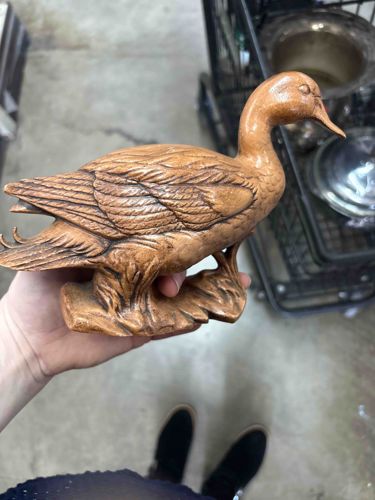
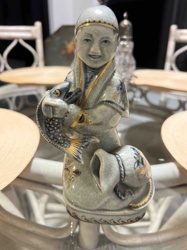
This item is a ceramic figurine depicting a duck, likely standing or in a walking posture, designed as a decorative art piece. The figurine exhibits a warm, earthy brown coloration, consistent across its entire surface, with variations in shade that suggest an antique or hand-finished appearance. The material is distinctly ceramic, possibly terracotta or a similar earthenware, given its opaque finish and slightly textured surface that mimics carved wood. The duck features finely sculpted details, particularly on its wings, where individual feathers are clearly delineated, creating a realistic and robust texture. The head and neck are smooth, contrasting with the wings, and the beak is pointed. The eyes appear to be closed or very subtly indicated with shallow indentations, suggesting a serene or stylized expression. The duck is perched on an integrated base that resembles natural terrain or a rocky outcropping, providing stability for display. While the exact dimensions are not provided, it appears to be substantial enough to be held comfortably in one hand, suggesting a length of approximately 8-12 inches. One notable feature, as per the additional context, is the 'Tyer' signature, which would be located on an unseen part of the figurine (likely the underside or base), indicating its maker. The craftsmanship suggests a moderately skilled artisan, focusing on naturalistic detail and a rustic aesthetic. There are no immediately visible chips, cracks, or significant damage, though some light wear or minor abrasions might be present on closer inspection, consistent with its likely age as an older ceramic piece. The overall condition appears good, with an intact form and consistent coloration. This decorative piece likely originates from the mid-20th century or earlier, given its traditional style and material choice.
AI Appraisal Report
Upon visual examination of the provided image, this ceramic duck figurine appears to be in good overall condition. There are no readily apparent chips, cracks, or significant losses. The earthy brown coloration is consistent, suggesting proper care or minimal exposure to harsh elements. The finely sculpted feather details and textured surface are well-preserved, indicating good craftsmanship for a decorative piece of its type. The integrated base provides stability, and the 'Tyer' signature, though unseen, is a crucial detail for authentication.
Market conditions for vintage ceramic animal figurines are moderate. While there's a steady interest in well-executed pieces, particularly those with a recognizable artist or maker, the 'Tyer' signature is not immediately associated with a highly renowned or high-value ceramic artist. Comparable pieces by lesser-known or regional artists in similar condition typically fetch between $40 and $150, depending on the specific characteristics and sales venue. The naturalistic detail and rustic aesthetic contribute positively to its appeal, suggesting it would be attractive to collectors of vintage decorative arts or animal figurines.
Demand for ceramic duck figurines, while present, isn't exceptionally high unless it's a particularly rare or artistically significant piece. The value here is primarily driven by its decorative quality, good condition, and the presence of a maker's mark, which adds a layer of provenance. Without the 'Tyer' mark, the value would be considerably lower.
Limitations in authenticity verification from images alone are significant. While the visible craftsmanship appears consistent with a moderately skilled artisan of the mid-20th century, I cannot definitively confirm the authenticity of the 'Tyer' signature without physical inspection. An in-person examination would allow for a tactile assessment of the ceramic material, an examination of the signature's application (e.g., incised, hand-painted, or stamped), and a thorough check for any repairs, restorations, or subtle imperfections not visible in photographs. Provenance documentation, such as original sales receipts or family histories of ownership, would also greatly enhance the authentication process by linking the piece's history directly to the purported maker.