AI estimate as of October 2, 2025 · verify with a professional before acting
AI-Generated · Verify before acting
Everything on this page is generated by AI for informational purposes only. AI can make mistakes — the AI may misidentify items or misattribute them (artist, maker, brand, designer, origin, era). This is not an official valuation and should not be used for insurance, sale, tax, estate, legal, or lending purposes — or any decision requiring a certified appraisal. It is not an authoritative claim about any person, brand, or rights holder — do not share or rely on it as a factual statement about a third party. Always consult qualified professionals before making financial decisions.
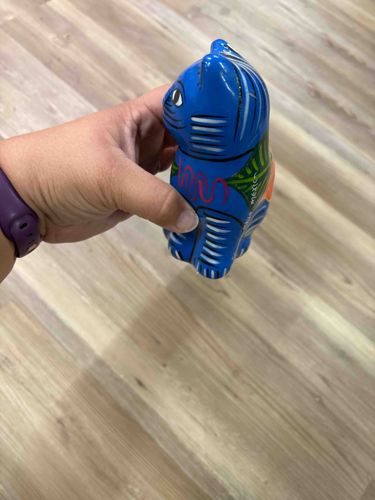
This item is a decorative ceramic cat figurine, exhibiting characteristics reminiscent of traditional Mexican Talavera or folk art styles. Its primary color is a vibrant cobalt blue, which serves as the base coat for an array of intricate hand-painted designs. The cat is depicted in a seated or standing upright posture, with its head slightly turned to the left. Notable features include large, expressive eyes painted in white with black pupils and black outlines, and white line details on its face, representing whiskers, and on its head and body, suggesting fur or decorative patterns. The body features curvilinear and geometric motifs in contrasting colors such as hot pink, lime green, and orange. Specifically, the word 'Mexico' is discernible on the side, oriented vertically, confirming its origin or inspiration. The craftsmanship appears to be hand-painted, displaying a somewhat rustic charm with slight irregularities that are common in folk art. The ceramic material has a glossy finish. There are no readily apparent significant condition issues such as chips, cracks, or significant paint loss from the visible areas. The overall impression is one of good preservation, with the colors remaining vivid. Its size appears to be moderate, fitting comfortably within a person's hand, suggesting it is a tabletop or shelf-sized ornamental piece. The age is difficult to determine precisely without further markings, but its style suggests it could be a contemporary piece inspired by traditional Mexican handicraft, possibly from the late 20th or early 21st century.
AI Appraisal Report
I have examined the provided image of this Mexican Talavera Style Ceramic Cat Figurine. The item presents in good condition, showing no visible chips, cracks, or significant paint loss on the areas presented in the image. The colors remain vivid, and the glossy finish appears intact. Authenticity as a Talavera *style* piece is evident through its design motifs, color palette, and the 'Mexico' marking, which confirms its origin or inspiration, rather than adherence to strict Talavera D.O.C. standards. It is clearly a hand-painted ceramic piece, exhibiting the charming irregularities typical of folk art.
Market conditions for decorative Mexican folk art ceramics, especially animal figurines, are generally stable. Comparable items featuring similar hand-painted designs and quality often retail in the $30-$70 range, sometimes higher for larger or more intricately detailed pieces from known artisans. Demand is consistent for decorative items of this nature, appealing to collectors of Mexican folk art and those seeking colorful accent pieces. However, it is not a rare item; many such pieces are produced for the tourist and general decor markets. The primary value is decorative rather than historical or artistic rarity.
Factors impacting value include its good condition, appealing design, and artisanal quality. The 'Mexico' marking is common and does not inherently increase value beyond confirming origin. Without a signature or specific maker's mark beyond 'Mexico', it is challenging to attribute it to a particular artist or workshop, limiting its collectibility as a unique artistic piece.
My assessment of authenticity and condition is based solely on the visual examination of the provided image. For full authentication, particularly regarding the specific type of clay or glaze composition, and to definitively rule out any hairline cracks, crazing, or repairs not visible in the image, a physical in-person examination would be necessary. Provenance documentation, such as purchase receipts or artist information, would further enhance its value and confirm its specific origin within Mexico.