AI estimate as of November 10, 2025 · verify with a professional before acting
AI-Generated · Verify before acting
Everything on this page is generated by AI for informational purposes only. AI can make mistakes — the AI may misidentify items or misattribute them (artist, maker, brand, designer, origin, era). This is not an official valuation and should not be used for insurance, sale, tax, estate, legal, or lending purposes — or any decision requiring a certified appraisal. It is not an authoritative claim about any person, brand, or rights holder — do not share or rely on it as a factual statement about a third party. Always consult qualified professionals before making financial decisions.
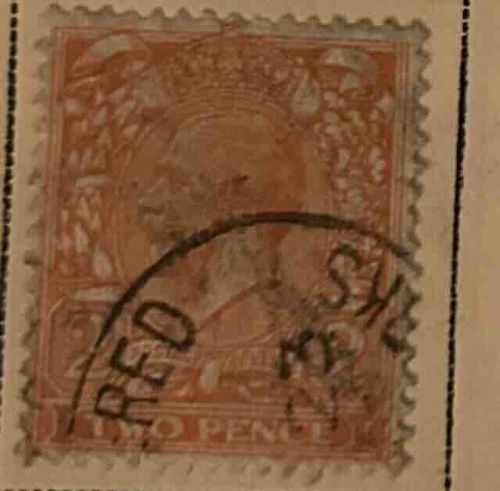
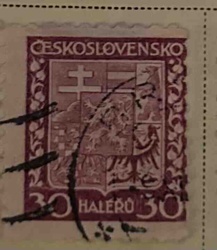
This item is a used British postage stamp, commonly known as a Penny Red, specifically the 'TWO PENCE' denomination. The stamp features a profile bust of Queen Victoria, facing left, set within an elaborate oval frame adorned with floral or ornate scrollwork. The primary color of the stamp appears to be a reddish-brown or rust tone, consistent with the 'Red' in its common name, printed on what seems to be white or off-white paper. It is rectangular in shape with perforated edges, indicating it was separated from a sheet of similar stamps. The visible condition includes a significant postmark in black ink, partially obscuring the queen's portrait and extending across the lower half of the stamp. The postmark appears to be a partial circular or oval cancellation with discernible letters "RED" on the left side and "SK" on the right, suggesting it was used in a specific postal district. The text "TWO PENCE" is clearly visible at the bottom center of the stamp. There are no obvious tears or major creases, however, the clarity of the image is somewhat limited, preventing a precise assessment of minute imperfections. The perforations appear relatively intact, though some might be bent or slightly damaged due to handling and cancellation. The general impression is of a vintage, authentic used postage stamp, characteristic of the Victorian era. The craftsmanship is typical of 19th-century philatelic production, with fine line engraving details visible in the queen's portrait and the surrounding decorative elements.
AI Appraisal Report
I have examined the provided image of what appears to be a used British Penny Red stamp, specifically of the 'TWO PENCE' denomination, featuring Queen Victoria. Based on the visual evidence, the stamp exhibits characteristics consistent with authentic Victorian-era philately, including the distinctive profile bust, reddish hue, and perforated edges. The visible 'TWO PENCE' inscription and the general design align with known Penny Red varieties. The stamp is clearly postmarked with black ink, partially covering the portrait and showing remnants of a circular cancellation with 'RED' and 'SK' visible. This postmark confirms its used status and provides a potential, albeit incomplete, clue to its origin.
In terms of condition, the stamp appears to be in fair to good used condition. There are no obvious tears or significant creases, which is a positive. However, the heavy cancellation does obscure parts of the design, which generally reduces collectibility and value compared to lightly cancelled or uncancelled examples. The clarity of the image limits my ability to discern minute imperfections such as thins, minor paper damage, or specific perforation issues beyond generally intact edges. Authenticity, based solely on this image, seems probable but cannot be definitively confirmed without a physical inspection.
Regarding market conditions, Penny Reds are generally common, especially used examples. While the 'TWO PENCE' denomination is slightly less common than the 'ONE PENNY', it is not considered rare unless it possesses specific plate numbers, watermarks, or varieties not discernible here. Demand exists from broad philatelic collectors, but the market for heavily cancelled common issues is typically modest. Comparables for a similar heavily cancelled example would range in the lower to mid-double digits.
Factors impacting value significantly here are the heavy cancellation, which degrades visual appeal, and the lack of verifiable rare characteristics (e.g., specific plating, unlisted varieties) which are impossible to ascertain from the image provided. For full authentication and a more precise valuation, I would require an in-person examination to assess paper quality, watermark, gum (if any remnants), exact perforation count, plate number (if present and legible), and to confirm the absence of repairs or hidden flaws. Provenance documentation, though unlikely for such a common used stamp, would also add to its verifiable history.