AI Appraisal Estimate

AI-generated estimates · not official valuations

From the user

What was submitted

Photo and notes provided by the user — not generated by AI

Submitted item photo
Submitted photo · June 30, 2026

User's notes

No additional notes provided.

AI analysis below

AI appraisal

AI analysis & estimate

AI-Generated · Verify before acting

Everything below is generated by AI for informational purposes only. AI can make mistakes — the AI may misidentify items or misattribute them (artist, maker, brand, designer, origin, era). This is not an official valuation and should not be used for insurance, sale, tax, estate, legal, or lending purposes — or any decision requiring a certified appraisal. It is not an authoritative claim about any person, brand, or rights holder — do not share or rely on it as a factual statement about a third party. Always consult qualified professionals before making financial decisions.

Read the full disclaimer

AI Identification

·Not independently authenticated·Verify before acting

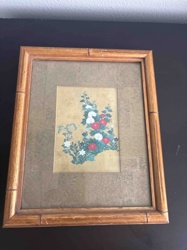
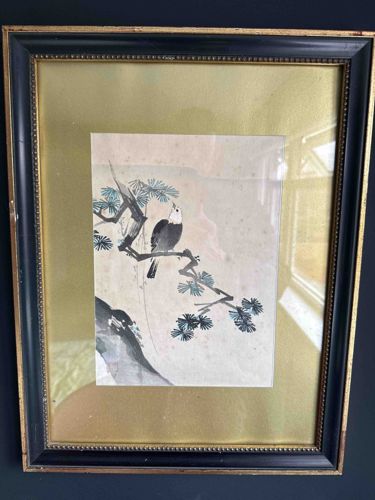
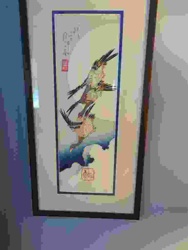
Framed Japanese Kachō-ga (Bird and Flower Painting) in Woodblock Style

Fine Art / Asian Art

AI Estimated Value

·Not an official valuation·Verify before acting

$150 - $300

As of June 30, 2026

AI Item Analysis

·AI can make mistakes·Verify before acting
This item is a framed piece of East Asian artwork, likely a Japanese woodblock print or a painting in the Kachō-ga style, depicting a bird perched on a gnarled pine branch. The central composition features a monochromatic bird with a white head and dark body, rendered with delicate ink-wash techniques. The pine needles are executed in a contrasting blue-green hue, arranged in stylized clusters on angular, dark branches that evoke the aesthetics of the Meiji or Showa eras. The artwork is executed on paper which shows significant age-related foxing, spotting, and general yellowing of the substrate, particularly visible in the negative space. The piece is housed in a decorative wooden frame featuring a black-painted finish with gilded inner and outer edges and a beaded inner border. The gold-toned matting provides a wide margin around the central image. Condition issues include visible scuffing and paint loss along the frame's edges, revealing the wood beneath, and significant debris or fungal growth visible between the glass and the matting. No artist signature or seal is immediately visible in the current framing, though one may be present beneath the mat. The overall craftsmanship suggests a mid-20th-century reproduction or a late 19th-century mass-produced print intended for the export or decorative market.
AI Appraisal Report

·AI can make mistakes·Verify before acting
I have conducted a visual examination of the framed Kachō-ga (bird-and-flower) artwork. The composition follows the stylistic conventions of the Meiji or Showa eras, utilizing ink-wash techniques for the avian subject and a stylized blue-green palette for the pine needles. While the imagery is evocative of traditional Japanese 'Suibokuga' or woodblock traditions, the lack of a visible signature or seal suggests this may be a mid-20th-century decorative reproduction or a mass-produced print intended for the export market. The condition of this piece is a primary factor in its valuation. There is significant foxing, atmospheric spotting, and substrate acidification. Of particular concern is the visible debris and potential fungal growth trapped behind the glass; if this is mold, it poses a long-term risk to the paper fibers and reduces the item's desirability for serious collectors. The frame, while decorative, shows significant scuffing and loss of gilding. The market for mid-tier Japanese decorative art remains stable, but buyers are currently prioritizing 'mint' condition or pieces with verifiable provenance to known artists (e.g., Ohara Koson). The lack of a seal and the poor state of preservation relegate this piece to the 'decorative' category rather than 'fine art investment.' Limitations: This appraisal is based solely on digital images. A definitive determination of the medium—distinguishing between a hand-painted original, a woodblock print, or an offset lithograph—requires a physical inspection under magnification to identify ink penetration and paper grain. I would also recommend unframing the piece to search for a hidden signature on the margins and to professionally treat the biological growth to prevent further deterioration.

Get your items appraised

Instant estimates of your treasures with AI-powered appraisals

Browse More Appraisals