AI Appraisal Estimate

AI-generated estimates · not official valuations

From the user

What was submitted

Photo and notes provided by the user — not generated by AI

Submitted item photo
Submitted photo · May 27, 2026

User's notes

Age

AI analysis below

AI appraisal

AI analysis & estimate

AI-Generated · Verify before acting

Everything below is generated by AI for informational purposes only. AI can make mistakes — the AI may misidentify items or misattribute them (artist, maker, brand, designer, origin, era). This is not an official valuation and should not be used for insurance, sale, tax, estate, legal, or lending purposes — or any decision requiring a certified appraisal. It is not an authoritative claim about any person, brand, or rights holder — do not share or rely on it as a factual statement about a third party. Always consult qualified professionals before making financial decisions.

Note

This analysis also relies on unverified notes provided by the user, which may be incomplete or inaccurate and could affect the result.

Read the full disclaimer

AI Identification

·Not independently authenticated·Verify before acting

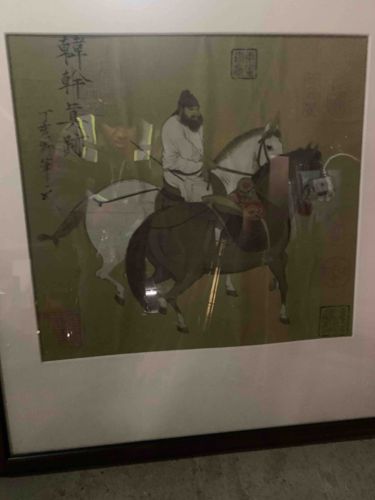
Framed Print of 'Heard of Horses' after Han Gan

Fine Art - Asian Art Reproductions

AI Estimated Value

·Not an official valuation·Verify before acting

$100 - $250

As of May 27, 2026

AI Item Analysis

·AI can make mistakes·Verify before acting
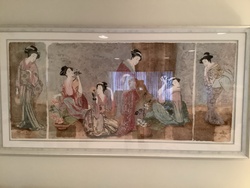
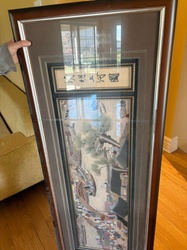
This item is a framed reproduction of a classical Chinese painting, specifically styled after the Tang Dynasty master Han Gan (c. 706–783 AD). The artwork depicts a bearded groom or official in traditional white robes riding a dark stallion while leading a white horse. The scene is rendered on a surface that mimics aged silk with a muted olive-green or mustard background. Key physical characteristics include columns of black calligraphic script on the upper left and multiple red cinnabar-style seals (stamps) scattered across the composition, intended to represent imperial or collector marks common in historic Chinese art. The colors are predominantly earth tones, with strong contrast between the dark and light horses. The item is presented in a modern, dark wooden frame with a wide white mat board protected by glass. Notable condition issues include visible surface glares and reflections in the photograph, along with slight undulations in the paper or silk substrate, suggesting it may not be perfectly flat against the mounting. Based on the uniform application of the seals and the modern framing style, this appears to be a mid-to-late 20th-century decorative print rather than a period artifact or high-end hand-painted copy. The level of detail in the brushwork suggests a quality mechanical printing process or a student's hand-painted study, emphasizing the 'Gongbi' style of meticulous detail.
AI Appraisal Report

·AI can make mistakes·Verify before acting
I have examined the provided images of this framed reproduction after Han Gan. The piece is a decorative print on paper or synthetic silk, styled to resemble the Tang Dynasty masterpiece. While the composition captures the 'Gongbi' meticulous brushwork and the iconic spirit of Han Gan’s horses, several factors indicate this is a modern decorative object rather than a period artifact or high-value academic copy. Specifically, the uniform saturation of the cinnabar seals and the mechanical consistency of the calligraphic ink suggest a 20th-century lithographic or high-quality digital printing process. The slight undulations in the substrate and the contemporary framing with a wide white mat are typical of mid-to-late 20th-century home decor exports. The market for Asian art reproductions is highly saturated. This item's value is derived primarily from its aesthetic appeal as a decor piece rather than rarity or historical importance. Comparables for framed Chinese prints of this size and quality typically sell at estate auctions or through secondary decor markets in the identified range. The value is capped by its status as a mechanical reproduction. Limitations: This appraisal is based solely on digital images. A definitive assessment of age and technique requires an in-person examination to check for half-tone print patterns versus hand-painted ink absorption. To elevate the valuation to that of a 'hand-painted study,' I would need to inspect the margins of the substrate for artist signatures and verify the ink's depth under magnification. No provenance was provided to suggest a specific collection history that would add a premium to the price.

Get your items appraised

Instant estimates of your treasures with AI-powered appraisals

Browse More Appraisals