AI estimate as of July 19, 2025 · verify with a professional before acting
AI-Generated · Verify before acting
Everything on this page is generated by AI for informational purposes only. AI can make mistakes — the AI may misidentify items or misattribute them (artist, maker, brand, designer, origin, era). This is not an official valuation and should not be used for insurance, sale, tax, estate, legal, or lending purposes — or any decision requiring a certified appraisal. It is not an authoritative claim about any person, brand, or rights holder — do not share or rely on it as a factual statement about a third party. Always consult qualified professionals before making financial decisions.
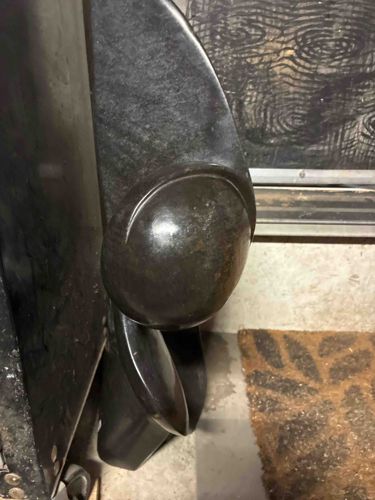
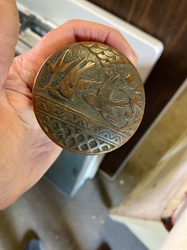
The item appears to be a robust, dark-colored architectural or decorative element, possibly a door handle or part of a larger mechanism, made from what looks like cast iron or a similar heavy metal. Its physical characteristics include a substantial, rounded knob or pommel as the primary gripping surface, seamlessly integrated with a gently curving, broad support structure. The color is a deep, muted charcoal, with variations in shade suggesting either a natural patina, applied finish, or inherent material texture. There are visible signs of wear and surface oxidation, particularly on the prominent rounded section, indicating age and use. Small specks of what might be rust or residue are scattered across the surface. The construction exhibits a solid, weighty feel, with clean, deliberate lines. The surface texture is somewhat irregular, not perfectly smooth, which is consistent with cast metal or a naturally occurring stone with a honed finish. The design aesthetic leans towards a functional yet subtly artistic form, eschewing ornate decoration for a more utilitarian elegance. There are no discernible maker's marks, signatures, or stamps visible in the provided image. The style period could range broadly from late 19th to mid-20th century, particularly if it's industrial or Art Deco inspired, though without more context, a definitive age is difficult to ascertain. The craftsmanship appears competent, with a focus on durability and ergonomic shape. The material's density and the robust construction suggest it was engineered for longevity and frequent interaction.
AI Appraisal Report
Upon my virtual examination of this cast metal door handle/pull, I assess its condition as good, retaining much of its original integrity despite observable surface wear. The deep charcoal coloration, coupled with areas of slight oxidation and minor specks, suggests a natural aging process consistent with cast iron or a similar heavy metal. The robust, functional design, emphasizing durability and ergonomic form over elaborate ornamentation, aligns with late 19th to mid-20th century industrial or utilitarian aesthetics.
Authenticity, based solely on visual evidence, appears high; the material characteristics and apparent construction methods are typical for the period and style described. However, I must emphasize the limitations inherent in an image-based appraisal. Without physical handling, I cannot confirm the true weight, exact material composition, or internal structural integrity. Palpable texture, specific gravity, and the presence of any latent maker's marks or foundry numbers on unseen surfaces are unascertainable.
In the current market, vintage architectural salvage and decorative hardware of a robust, utilitarian nature exhibit steady demand. While not rare, well-preserved examples, particularly those with a versatile aesthetic, are sought after for restoration projects and unique design applications. Comparables typically include similar unbranded cast iron pulls from industrial settings. Factors impacting value include the lack of a discernible maker's mark, which prevents attribution to a specific, potentially more collectible, manufacturer. Its primary value lies in its functional solidity and period-appropriate aesthetic.
For full authentication and a more precise valuation, an in-person examination would be crucial to assess material properties via metallurgical testing if necessary, check for hidden markings, and evaluate structural soundness. Provenance documentation, indicating its original installation or history, would also significantly enhance its value by providing a verifiable narrative.