AI estimate as of November 9, 2025 · verify with a professional before acting
AI-Generated · Verify before acting
Everything on this page is generated by AI for informational purposes only. AI can make mistakes — the AI may misidentify items or misattribute them (artist, maker, brand, designer, origin, era). This is not an official valuation and should not be used for insurance, sale, tax, estate, legal, or lending purposes — or any decision requiring a certified appraisal. It is not an authoritative claim about any person, brand, or rights holder — do not share or rely on it as a factual statement about a third party. Always consult qualified professionals before making financial decisions.
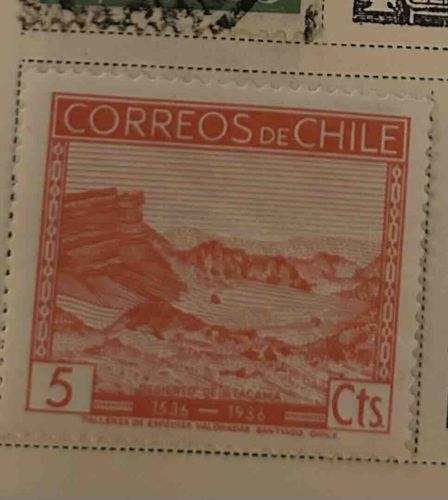
This item is a Chilean postage stamp, primarily red/orange in color with white details, depicting a landscape scene of the Atacama Desert. The stamp is rectangular with perforated edges, indicating it was intended for postal use and was likely part of a larger sheet. The central image portrays a rugged, mountainous, or hilly desert terrain, possibly with some form of water body or dry riverbed in the foreground, rendered in a stylized, somewhat linear or etched artistic style. Above the landscape, in a white banner against the red background, the text 'CORREOS DE CHILE' is clearly visible, identifying the issuing country and purpose. At the bottom left, a white square contains '5', indicating a denomination of 5 units. To the right of the landscape, also against the red background, 'Cts' is printed in white, signifying 'Centavos'. Below the main image, in a smaller font, is the inscription 'DECIERTO DE ATACAMA' and below that '1536 — 1936', suggesting a commemorative issue, possibly marking a 400-year anniversary related to the Atacama Desert. Further below, a very small line of text, difficult to fully decipher but appears to be 'TALLER DE ESPECIES VALORADAS SANTIAGO - CHILE', likely indicates the printer and location. The stamp's condition appears relatively good, with crisp perforations and no significant visible creasing or damage. The color is vibrant, consistent with its age. Given the '1936' date, it belongs to that era, characterized by detailed illustrative designs and a focus on national landmarks or historical events in philately. The borders feature a decorative pattern of interconnected ovals along the vertical sides, and horizontal lines along the top and bottom, framing the central image effectively. The overall quality of printing appears fine for a postage stamp of this period, with clear lines and text.
AI Appraisal Report
I have examined the provided image of the Chilean '1536-1936 Decierto de Atacama' 5 Cts Postage Stamp. Based on this visual assessment, the stamp appears to be in 'Fine to Very Fine' condition. The perforations are intact and well-separated, the centering seems reasonable for the era, and the colors (red/orange and white) are vibrant with good registration. There are no obvious tears, creases, or major thins visible in the image. The text and design elements are sharp, suggesting good printing quality for a stamp of this period.
Authenticity, based solely on an image, is difficult to definitively confirm. However, the design, iconography, and text align with known issues for Chilean stamps commemorating the Atacama Desert in 1936. There are no immediate red flags suggesting a crude forgery.
Market conditions for this particular issue are generally stable. This stamp is part of the '1936 Atacama Desert Centennial' series (Scott #229 according to standard catalogs, assuming this is the 5 centavos 'Atacama Desert' design). While attractive, it's not considered a high-value rarity. Demand is moderate among collectors specializing in Chilean philately or thematic collections of landscapes/deserts. Its rarity is low to moderate; it was issued in significant quantities.
Factors impacting its value positively include its apparent good condition. Negative factors, if present but not visible, could include hidden defects like thins, repairs, or heavy hinging. The primary limitation of this appraisal is the lack of physical examination. A full authentication would require in-person inspection to verify paper type, watermark (if any), gum condition, absence of repairs, and to detect any subtle printing errors or alterations that differentiate authentic stamps from potential forgeries or reprints. Provenance (history of ownership) is also always valuable but not available here. Assuming it is a genuine, unused stamp in the observed condition, a fair market value would typically fall within the range of $5 to $15.