AI Appraisal Estimate

AI-generated estimates · not official valuations

From the user

What was submitted

Photo and notes provided by the user — not generated by AI

Submitted item photo
Submitted photo · June 27, 2026

User's notes

No additional notes provided.

AI analysis below

AI appraisal

AI analysis & estimate

AI-Generated · Verify before acting

Everything below is generated by AI for informational purposes only. AI can make mistakes — the AI may misidentify items or misattribute them (artist, maker, brand, designer, origin, era). This is not an official valuation and should not be used for insurance, sale, tax, estate, legal, or lending purposes — or any decision requiring a certified appraisal. It is not an authoritative claim about any person, brand, or rights holder — do not share or rely on it as a factual statement about a third party. Always consult qualified professionals before making financial decisions.

Read the full disclaimer

AI Identification

·Not independently authenticated·Verify before acting

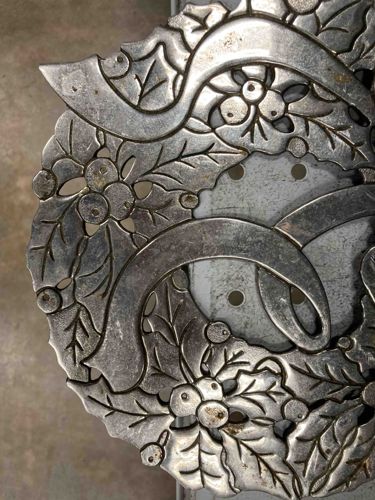
Cast Pewter Holiday Holly and Ribbon Trivet

Antique and Vintage Kitchenware / Decorative Arts

AI Estimated Value

·Not an official valuation·Verify before acting

$15 - $25

As of June 27, 2026

AI Item Analysis

·AI can make mistakes·Verify before acting
This item is a decorative trivet, likely crafted from cast pewter or a similar heavy-base metal alloy with a dull silvery finish. The piece features an intricate openwork or pierced design depicting a seasonal holiday wreath composed of holly leaves, clusters of berries, and flowing undulating ribbons. The construction appears hefty, with significant thickness to the metal, characteristic of sand-cast decorative housewares common in the late 20th century. The metallic surface shows a distinct matte patina with consistent fine surface scratching and several areas of dark oxidation and pitting, particularly visible around the berry clusters and the inner crevices of the leaf veins. This wear is indicative of use and age, suggesting the piece was handled or used to hold hot dishes. There are no maker's marks visible in this close-up view, but the style is consistent with mid-to-late 20th-century Americana giftware, such as those produced by Wilton Armetale or similar foundries. The craftsmanship shows good detail in the veining of the leaves and the rounded form of the berries, though some casting seams may be present upon closer inspection of the edges. Small circular holes in the background suggest this may be part of a larger object or designed with specific drainage/venting in mind.
AI Appraisal Report

·AI can make mistakes·Verify before acting
Based on my visual inspection of the cast metal holiday trivet, I have identified it as a late 20th-century decorative household item, most likely composed of an aluminum-based ‘pewter-substitute’ alloy like Armetale. The design features a classic seasonal motif of holly and ribbons with pierced openwork. My examination reveals the piece is in ‘Good’ condition; while the structural integrity is sound, the matte finish shows significant surface scratching, pitting, and dark oxidation in the crevices, which are consistent with regular culinary use and heat exposure. The lack of a visible maker’s mark slightly hinders domestic brand identification, though the casting quality is consistent with mass-produced Americana giftware from the 1970s through the 1990s. The market for this specific category remains saturated. While companies like Wilton Armetale have a dedicated secondary market, these items were produced in high volumes, making them common finds in estate sales and vintage marketplaces. Their value is primarily functional and decorative rather than as a rare investment-grade antique. Demand peaks seasonally during the winter holidays. Limitations: My assessment is based solely on digital images. Without physical handling, I cannot perform a ‘ring test’ to distinguish the specific density of the alloy or check for the presence of lead found in true antique pewter. Full authentication would require a tactile search for foundry marks on the reverse side and potentially an X-ray fluorescence (XRF) test to verify the exact metal composition. A definitive valuation would also depend on verifying the manufacturer via specific mold hallmarks not visible here.

Get your items appraised

Instant estimates of your treasures with AI-powered appraisals

Browse More Appraisals